Showing posts with label "When you go out". Show all posts

Friday, August 21, 2026

Remember...

      There is a term called "worldview". It is defined as "the mental framework or lens through which a person or group views, interprets and makes sense of the world and reality. It shapes how a person answers big life questions, defines right and wrong, and makes daily choices." Each individual comes to a world understanding based upon what they know is the truth, and also by what they have personally experienced. I found that in this Sabbath reading portion titled Ki Teitze, which means "When you go out", the LORD repeatedly gives the Israelites a "worldview" which they are to keep in mind when applying the Law which the LORD had given to Moses, and their view of the world in general.

     The Book of Deuteronomy, in which this Sabbath reading begins, contains the final words (dabarim/d'varim) of Moses to the younger generation of Israelites as they are about to end their journey through the wilderness and enter into the land which the LORD had promised to their fathers. The older generation, which was a rebellious generation, has just about passed away as the LORD said would happen before entering the land. The title, "When you go out" is used several times, including Deut. 20:1, Deut. 21:10 and Deut. 23:9. The phrase is connected in these verses with battle: "When you go out to battle against your enemies, and see horses and chariots and people more numerous than you, do not be afraid of them; for the LORD your God is with you, who brought you up from the land of Egypt." And: "When you go out to war against your enemies, and the LORD your God delivers them into your hand, and you take them captive....". Also, "When the army goes out against your enemies, then keep yourself from every wicked thing." The LORD gave instructions regarding how the Israelites should conduct themselves "when they go out...". 

     The rest of the instructions of Moses in these assigned chapter readings, as well as previous readings, regarding the keeping of the Law is to be based upon a certain "worldview". Here are some examples:

     In showing generosity and kindness to a fellow countryman who has been sold to you and is now to be released in the seventh year (which is the LORD's Release), the master is to bestow on this former slave/servant liberal provisions with which to start his life again. This generosity and mercy are to be carried out with this "worldview": "You shall remember that you were a slave in the land of Egypt, and the LORD your God redeemed you; therefore I command you this (*aleph-tav/Alpha and Omega)-thing (dabar) today." (Deut. 15:12-15).

     As the LORD described His Feasts which the Israelites must keep including (*aleph-tav/Alpha and Omega)-Passover and the Feast of Weeks/Shavuot/Pentecost which was to include rejoicing with their children, their servants, the local Levite, the stranger, the fatherless and the widow, the LORD related these feasts to their deliverance from Egypt. He concluded by saying: "And you shall remember that you were a slave in Egypt, and you shall be careful to observe the (*aleph-tav/Alpha and Omega)-statutes." (Deut. 16:1-12).

     In another example: "You shall not pervert justice due to the stranger or the fatherless, nor take a widow's garment as a pledge. But you shall remember that you were a slave in Egypt, and the LORD your God redeemed you from there; therefore I command you to do this (*aleph-tav/Alpha and Omega)-thing (dabar).

     "When (ki - see Sabbath portion title) you reap your harvest in your field...When you beat your olive trees, you shall not go over the boughs again...When you gather the grapes of your vineyard, you shall not glean it afterward; it shall be for the stranger, the fatherless, and the widow. And you shall remember that you were a slave in the land of Egypt; therefore I command you to do this (*aleph-tav/Alpha and Omega)-thing (dabar).

     Even the observance of the Sabbath must contain this "worldview": "Observe the Sabbath (*aleph-tav/Alpha and Omega)-day, to keep it holy, as the LORD your God commanded you. Six days you shall labor and do all your work, but the seventh day is the Sabbath of the LORD your God. In it you shall do no work: you, nor your son, nor your daughter, nor your male servant, nor your female servant, nor your ox, nor your donkey, nor any of your cattle, nor your stranger who is within your gates, that your male servant and your female servant may rest as well as you. And remember that you were a slave in the land of Egypt, and the LORD your God brought you out from there by a mighty hand and an outstretched arm; therefore the LORD your God commanded you to keep the Sabbath (*aleph-tav/Alpha and Omega)-day." (Deut. 5:12-15).

     It becomes clear what kind of "lens" (see worldview definition above) the LORD had commanded His people to see through when dealing with the commands of the LORD, including the Sabbath, and when dealing with each other, even when dealing with warfare, enemies and captives. The LORD connects the *aleph-tav/Alpha and Omega Messiah/Christ (see *note below) to the dabar things involved with remembering that they were slaves in Egypt and it was God who brought them out. This remembrance was their starting point and their continuation: Remember where you came from and how you got here. The LORD even prophesied that once His people arrived in the land promised to them and began to prosper, they would forget where they came from and how they got there and they would think that they accomplished it on their own. The LORD said this: "...when your heart is lifted up, and you forget (*aleph-tav/Alpha and Omega)-the-LORD your God who brought you out of the land of Egypt, from the house of bondage....then you say in your heart, 'My power and the might of my hand have gained me this wealth.' And you shall remember the LORD your God, for it is He who gives you power to get wealth, that He may establish (*aleph-tav/Alpha and Omega)-His-covenant which He swore..." (Deut. 8:14-18). Their remembrance or their forgetting of the LORD's commanded worldview will have an impact on their relationship with the *aleph-tav/Alpha and Omega LORD and His covenant.

     There is a stark illustration of this as Jesus spoke to a group who believed in Him: "Then Jesus said to those Jews who believed Him, 'If you abide in My word, you are My disciples indeed. And you shall know the truth, and the truth shall make you free.' They answered Him, 'We are Abraham's descendants, and we have never been in bondage to anyone. How can You say, 'You will be made free?' Jesus answered them, 'Most assuredly, I say to you, whoever commits sin is a slave of sin. And a slave does not abide in the house forever, but a son abides forever. Therefore if the Son makes you free, you shall be free indeed." (Jn. 8:31-34). Uh-oh, they forgotten what God had told them to remember. They changed the commanded "lens" through which they were to view themselves, each other, the law, and even their enemies. Now their "lens" had become being the descendants of Abraham according to the flesh. The (*aleph-tav/Alpha and Omega)-things (dabar) of God are not defined by man's flesh, but by God's Spirit. They even denied that they had ever been slaves, saying this while they were then under the oppressive boot of the Roman Emperor and his puppets, the Herods. This group that Jesus was talking to were so offended by His words of salvation freedom in the truth of God and His Son that they wanted to kill Him! (Jn. 8:58-59). Needless to say, they missed that particular day of their visitation and salvation, remaining slaves to sin and its consequence - eternal death - because they forgot to remember.

     From another reading portion from this Ki Teitze, "When you go out" Sabbath, the Book of Proverbs tells us about a generation that does not remember the God of their deliverance: "There is a generation that curses its father, and does not bless its mother. There is a generation that is pure in its own eyes, yet is not washed from its filthiness. There is a generation - oh, how lofty are their eyes! And their eyelids are lifted up. There is a generation whose teeth are like swords, and whose fangs are like knives, to devour the poor from off the earth, and the needy from among men." (Prov. 30:11-14). I think we can say that this generation being spoken of here, as also the one shown by the example above, does not remember that they were slaves in Egypt, but were delivered out of the house of bondage by the power and mercy of the LORD.

     From the same proverb, the writer asks us to remember and answer: "Who has ascended into heaven, or descended?...Who has established all the ends of the earth? What is His name, and what is His Son's name, if you know? (v. 4). Do we know those names, the writer is asking, or do we only know our own names and self-importance?

     How do these *aleph-tav/Alpha and Omega-things (dabar) apply to us, who have already believed and been saved by Jesus Messiah/Christ? God's miraculous deliverance of the Israelites at Passover from their heavy burden of slavery in Egypt, which they are always to remember, was also a prophetic foreshadowing of our deliverance from the slavery to sin and death by the blood of our Passover Lamb of God, Jesus (see 1 Cor. 5:7-8). We were slaves to the world, sin and death and have been brought out of that slavery by *aleph-tav/Alpha and Omega-the-LORD. We have been promised glorious things as the now sons and daughters of God in Christ. However, I think that the moment that we forget where we came from and how we got here, our witness in the earth is compromised. Paul wrote about this. He challenged the Church about how the believers were treating each other. They were cheating each other and suing each other in the courts over slights. He wrote: "...you do these things to your brethren! Do you not know that the unrighteous will not inherit the kingdom of God?... And such were some of you. But you were washed, but you were sanctified, but you were justified in the name of the Lord Jesus and by the Spirit of our God." (1 Cor. 6:7-11).

     We can't forget where we came from and how we got here. We can't ignore the "lens" through which the LORD commanded us to view ourselves, each other, the law as fulfilled by Christ, the *aleph-tav/Alpha and Omega-things (dabar), and even our enemies, or change it into a different kind of "lens". 

     Paul also wrote: "But God demonstrates His own love toward us, in that while we were still sinners, Christ died for us. Much more then, having now been justified by His blood, we shall be saved from wrath through Him. For if when we were enemies we were reconciled to God through the death of His Son, much more, having been reconciled, we shall be saved by His life." (Rom. 5:8-10). We did not save ourselves, nor were we ever able to. We did not reconcile ourselves to a holy God, nor were we ever able to. We must remember where we came from and how we got here. If we DO remember, it shows in our view of ourselves, each other, and even our enemies. If we DO remember, it shows in the thoughts of our hearts and the *aleph-tav/Alpha and Omega-words (dabar) out of our mouths. If we DO remember, we show ourselves to be the peculiar and special people that God called us to be. If we DO remember, our fruit changes from fruits of shame to fruits of holiness and everlasting life (see Rom. 6:20-23). When we DON'T remember, that shows too.

     I don't know if you come from the same place as I do, but I was lost and chained in darkness. However, according to my previous "worldview," this seemed like normal life. This is all I knew. Not only was I lost and chained in darkness in a pit of death, but I was too ignorant to know that I was lost and chained. I was so ignorant that I did not know as truth that there was only one true God of perfect holiness, grace, and love, so I didn't seek Him. I didn't find Jesus Messiah/Christ, He found me. It was not until He found me that I began to understand that He had set me free from slavery, darkness and the chains of death. Yes, I know and believe that we are many wonderous things as we abide in Christ for His purpose and use, but I don't ever want to forget where I came from and how I got here.

     "But you shall remember that you were a slave in Egypt, and the LORD your God redeemed you from there; therefore I command you to do this (*aleph-tav/Alpha and Omega)-thing."

     If you would like to learn more about these (*aleph-tav/Alpha and Omega)-things, you can join my prayer: Dearest LORD and Father, while I was yet a slave, You sent Your beloved Son, Jesus, to find me and set me free. When I didn't love You, You loved me. While I was still sinning and dying, You sent Jesus to save me. Jesus sent the Holy Spirit in a moment to quicken me while I was dead and raise me up with Jesus to eternal life of Oneness with You, the God of heaven and earth. Father, let me never forget. Father, let me always view the world through this lens of miraculous mercy and the holy power of God Almighty. I would be enshrouded in deep darkness without You. I would be dead without You. Help me to lead others into Your love, light and life. I ask this in the name of my Savior Jesus. AMEN."

*NOTE: aleph-tav written in Hebrew as אֶת, are the first and last letters of the Hebrew alphabet. The meaning of the two pictographic Hebrew letters can also be interpreted "Adonai (Lord) of the Cross/Covenant". In the New Testament, these letters are translated as Alpha and Omega written as ΑΩ, the first and last letters of the Greek alphabet. These letters are those by which Jesus Christ identifies Himself in the Book of Revelation: see Rev. 1:8, Rev. 21:6, Rev. 22:13. 


Friday, September 5, 2025

BattleForLife

      There is an enemy that is against all life and there is a warfare for life, not only for physical life but for spiritual or everlasting life. It would seem that death is winning in this generation. Pope John Paul II called this "a culture of death". However, I believe that the believers in Messiah/Christ Jesus are a secret weapon in this warfare for life. This is what was brought to my mind as I looked at the scriptures that carry the title words of this week's Sabbath reading portion titled Ki Teitze, meaning "When you go out."

     This phrase is used three times in or around this Sabbath reading portion: 

  • "When you go out to battle against your enemies...do not be afraid of them; for the LORD your God is with you, who brought you up from the land of Egypt." (Deut. 20:1)
  • "When you go out to war against your enemies, and the LORD your God delivers them into your hand..." (Deut. 21:10).
  • "When the army goes out against your enemies, then keep yourself from every wicked thing...then he (meaning the accidentally unclean) shall go outside the camp...he shall wash with water; and when the sun sets, he may come into the camp." (Deut. 23:9-11).

     As we can see above, the phrase "go/goes out" used in connection with this Sabbath Ki Teitze reading portion is associated with the going out in warfare against enemies. The Hebrew word which is translated as "go out" is the word yasa which means "go forward, come forth, depart, proceed to something, come or go forth with a purpose for a result, bring out, lead out." However, also included in the meaning of yasa is "begotten, break out, shoot forth, spread, spring out." Conception, birth and life are part of the meaning, and part of the warfare. 

     The "battle" (see Deut. 20:1 above) and "war" (see Deut. 21:10 above) is the word milhama, which has the root word laham meaning "fight, overcome, eat, devoured, prevail, to eat or use as food." Joshua and Caleb used this meaning when they described the enemy nations that were inhabiting the Promised Land which God gave to Israel: "...nor fear the people of the land, for they are our bread  (lehem/laham [see above] - food, eat, feast, banquets, meals/fight, make war, eat, overcome, devoured, prevail)...and the LORD is with us. Do not fear them." (Num. 14:8-9). This warfare is "Eat or be eaten."

     Deuteronomy 23:9-11 above refers to the "host or army" that goes out against the enemy. This word for army is mahane, meaning "camp, tents, armies, body of people, angels, battle," which has an important root word in Hebrew, hanan, that means "mercy, gracious, favor, pity, show consideration, stoop in kindness, pray, make supplication." Only the wisdom of the LORD could conceive through His language an army that goes out against the enemy that has its root existence and purpose in the mercy, grace and loving-kindness of God through prayer and supplication. The enemy tries to withstand the move of the grace of God towards man, grace being another expression of life, and the door to eternal life. Jesus is described in the Gospel as being full of grace and truth (Jn. 1:14), as He also described Himself as being "I am the way, the truth, and the life. No one comes to the Father except through Me." (Jn. 14:6). The Greek word used in this verse for "grace" is charis, and its meaning is very similar to the Hebrew word hanan above: "merciful kindness of God by which He influences souls and turns them to Christ, good will, loving-kindness, favor, the gracious divine influence upon the heart and its reflection in the life." It is the grace of God that saves our souls and our lives. (see Eph. 2:4-10).

     Not only does Jesus, full of grace and truth, have life in Himself, but He is the beginning source of life for all men: "All things were made through Him, and without Him nothing was made that was made. In Him was life, and the light was the life of men." (Jn. 1:3-4). We see that through the Person of Jesus Messiah/Christ both grace and life are joined together in meaning and power. Sometimes in our spiritual warfare regarding many things, we forget that one of the greatest spiritual victories that can be won is the prayerful application of the grace and mercy of God towards man, achieved through Christ, which yields not only life, but resurrection life. To separate grace and life from each other would be like trying to separate Christ into little pieces. He cannot be separated or divided. He is echad (unified into one whole with the Father and the Spirit).

     The verses above from Deuteronomy also mention an enemy or enemies. This is the Hebrew word oyeb/ayab meaning "enemy, foe, adversary, to hate." Peter described Satan as our adversary: "Be sober, be vigilant; because your adversary the devil walks about like a roaring lion, seeking whom he may devour (see milhama/laham above)...But may the God of all grace...perfect, establish, strengthen, and settle you. To Him be the glory and the dominion forever and ever. Amen." (1 Pet. 5:8, 10-11). The enemy cannot destroy the grace that saves. It is a sovereign gift from God that is not contingent upon man earning it, nor being "worthy" of it.

We tend to view grace as a quiet, gentle thing, but grace is so powerful that even the speaking of the word can level obstructing mountains into flat plains, and beget or bring forth the chief headstone, Messiah/Christ: "Who are you, O great mountain? Before Zerubbabel you shall become a plain! And he shall bring forth (see yasa above, including the meaning "begotten") the capstone (eben rosa - top most stone, headstone) with shouts of 'Grace, grace to it!" (Zech. 4:7, see also Eph. 1:22-23, Eph. 2:19-22, Col. 1:17-18).

     Jesus described Satan, the devil, and Jesus' own opposite purpose this way: "The thief does not come except to steal, and to kill, and to destroy (apollymi/apo - destroy, render useless, kill, devote or give over to eternal misery in hell. to perish, be lost, ruined, destroy fully/to separate one thing from another by which the union or fellowship of the two is destroyed, state of separation). I (Jesus speaking of Himself) have come that they may have life, and that they may have it more abundantly." (Jn. 10:10-11). One kills and One brings abundant life. Many do not believe in the existence of Satan, but God certainly did, as Satan is described in scripture. Jesus certainly believed in Satan and had encounters and conversation with him. Satan is counting on man's false belief that he doesn't exist - the easier it is then to devour man by separating him from fellowship (see apollymi/apo above) with the Lord, Who is life.

     From another reading in this Ki Teitze, "When you go out" Sabbath reading portion, we can see miraculous life brought forth from the lifeless through God's undeserved gift of mercy. The Hebrew word yasa, seen above, meaning "Go out," includes the meaning "begotten, shoot forth, spring up." In Isaiah 54, the prophet addresses the prophetic Word of the LORD to the barren: "Sing, O barren (aqar - barren of either male or female, sterile as if rooted out and destroyed in the generative organs, rooted up, plucked up, to cut, to exterminate), you who have not borne! Break forth into singing, and cry aloud, you who have not labored with child!...For your Maker is your Husband, the LORD of hosts (saba/seba - war, army, battle, warfare, soldiers, appointed time/fight, mustered into an army, go forth/out to war, wage war) is his name; and your Redeemer is the Holy One of Israel...For a mere moment I have forsaken you, but with great mercies (raham - compassion, merciful, the womb as cherishing the fetus, tender love, great tender mercy, pity, womb, love deeply, to obtain mercy) I will gather you. With a little wrath I hid My face from you for a moment; But with everlasting kindness I will have mercy on you,' says the LORD, your Redeemer...For the mountains shall depart and the hills be removed, but My kindness shall not depart from you, nor shall My covenant of peace be removed,' says the LORD, who has mercy on you...All your children shall be taught by the LORD, and great shall be the peace of your children." (Isa. 54:1-13, excerpt).

     The LORD was angry with His people as we see above. However, He turned again and poured out His mercy upon them, not because they did anything to "earn" His mercy, but because of His own love and compassion for them. The meaning of the Hebrew word for mercy used above, raham, has a direct connection with the fetus that is cherished in the womb, and is a synonym for the womb as we see above. As the mercy of God is poured out upon His people, the spiritually and physically barren will bring forth life. Mercy and life are connected to each other. As we again see in this Sabbath portion from Isaiah, in connection to this outpouring of mercy, the LORD calls Himself the LORD of hosts (see above), a name directly connected to armies and battle, as we saw at the beginning with our verses from Deuteronomy. There is a battle for mercy, a battle for grace, and a battle for life.

     The LORD of hosts fought that battle in the scriptures above from Isaiah for God's people. If we look at the chapter before Ch. 54, we see that the battle took place on the cross. Isaiah 53 shows us the battle. The devil meant for grace, mercy and life to die and be utterly destroyed that day as the Son of God was crucified for our sins, but the awesome power of God cannot be destroyed. The cross became instead a fountain of life (see Zech. 13:1-2) as God's grace and mercy were spoken and displayed from it. Jesus called each of us to this same battle (Lk. 9:23-25), if we are willing to carry forward the fight to our generation.

If you would like to know more about the battle for mercy, grace and life, you can join my prayer: "Dear Father, in the name of Your Son of mercy, grace and life, Jesus, I pray for a great outpouring of mercy and life for those who are perishing. I pray life, abundant life, eternal life, for the inhabitants of the earth. I pray that the battle for life is already won, and the whole earth is full of the glory of the LORD. Your mercy and grace saved my life, Lord, and I pray the same for the people of all the nations. Your grace is the divine power by which You touch the hearts and souls of men with mercy and bring them to the salvation knowledge of Your Son, Jesus. I ask for and speak this miracle victory in the hearts of men in the name of Jesus. AMEN."


Friday, September 13, 2024

Tassels


     This Sabbath's reading portion is titled Ki Teitze, meaning "When you go out". This phrase is used in Deut. 20:1, and 21:10. It is used in these circumstances: "When you go out to battle against your enemies, and see horses and chariots and people more numerous than you, do not be afraid of them; for the LORD your God is with you, who brought you up from the land of Egypt." Also: "When you go out to war against your enemies, and the LORD your God delivers them into your hands, and you take them captive..." The Ki Teitze phrase is connected here with battle and war against enemies.

     This week's portion begins in Deuteronomy chapters 22 through 25. These chapters cover a variety of laws as Moses reviews them with the people, but there is one verse concerning the garments to be worn by the Israelites that seems to be covered in mystery: "You shall not wear a garment of different sorts, such as wool and linen mixed together.  You shall make tassels on the four corners of the clothing with which you cover (yourself)." (Deut. 22:11-12). The assorted commandments in these chapters, including the commandment above dealing with clothing, have been specifically included with "When you go out", or battle. What could a tassle possibly have to do with going out to battle? We will have to seek out this mystery.

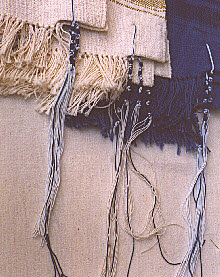
     The tassels or tzitzit that we see at the four corners of a prayer shawl or tallit are threads that have been folded over, twisted together and intricately knotted together to hang from the shawl. Often the explanation is given that the tassels are to serve as reminders of all of the (*aleph-tav/Alpha and Omega) commandments of God to do them, not following the sinful inclination our own hearts and eyes as is mentioned in Num. 15:38-40, and the tassels are tied in such a way as to reinforce this meaning, but the Hebrew meanings of the words in the verse above will take us even deeper. Let's look: "You shall make tassels..." (gadil/gadal - twisted threads, tassel, fringe, cord, rope, plaited locks, border of garment, intertwined threads, twisted work/magnify, great, grow, make powerful, praise, to do great things, make firm, become strong, of a king, lifted high, lifted up, salvation/yesua (Jesus) [Ps. 18:50], twist together, bind together). The twisting together and knotting to make the tassels does not just show us joined to and inseparable from God's commandments, but to God Himself, especially as associated with salvation. The name of God that includes the word for "tassel" is El HaGadol, or Great God, and Jehovah Gadal, "The LORD Magnified" (see Ps. 40:16). We can also see the application in warfare, as placed in this Sabbath reading as mentioned above, by the meanings in the word "tassel" of "make powerful, become strong, make firm."

     Continuing the Hebrew meanings found in the verse above from Deut. 22:12, "...on the four (arba/raba - four, square, foursquare, four sided) corners..." (kanap - feathered wing as covering, edge, border, extremity, corner of garment, coverlet, extremities of the earth, the highest summit of the temple, to cover over). In the importance of the number "four", we see the four-lettered name of God, YHWH: yod, heh, vaw, heh: "Behold the hand, behold the nail", and the foursquare nature of the City of God, the New Jerusalem come down from heaven (see Rev. 21:16), in which we also see the reference to this city being on a "great and high mountain " (see Rev. 21:10 and Isa. 2:2).

     In the meaning of "corners" from this phrase we see so many prophetic meanings here from the feathered wings of protection in Ps. 91:4, which are also the feathered wings of covering of the Messiah/Christ in Mt. 23:37, and in the eagle's wings that bore the Israelites out of Egypt in Ex. 19:4 and will bear them up again and keep them safe in the last days (see Rev. 12:13-17). We also see the corner of the coverlet wing with which Boaz covered his future wife Ruth as she sought his protection.  They would later bear the child who would be the grandfather of the future David, and his messianic lineage (see Ruth 3:7-9). 

     Continuing the verse from Deut. 22:12: "...on the clothing (kesut/kasa - covering, raiment, veiled like a married woman, a present given in order to obtain a pardon/cover, conceal, garment, the covering and concealing blood, the cloud covering that accompanies the appearing of God, to put on, overwhelm, to hide) with which you cover (kasa - see above) yourself..."

      The garment with tassels shares the same meaning as the covering with which God covers himself (Ps. 18:10-12, Ps. 97:2, Rev. 1:7-9, Rev. 19:11-13), the same meaning by which a veiled woman declares herself to be married as the Lord has married His people (Isa. 62:5, Isa. 54:5, Eph. 5:31-32, Rev. 19:7-9), and the same meaning as the covering power of the blood of sacrifice shed to cover sin (Lev. 17:11, Heb. 9:22, Heb. 10:19-22, Rev. 19:11-13). When these covering clothes with tassels are worn, it is like a gift given to gain pardon as in the robes of righteousness given to us (Isa. 61:10), and the pure white linen given to the saints to wear (Rev. 19:8).

     The commandment given by the LORD for the wearing of the tassels on the corners of the garment were also to include a single blue (tekelet/sehelet/sahal - violet thread, any color from the blue spectrum, the shellfish from which cerulean purple is made/the ingredient of holy incense, the pungent odor of the shell of the shellfish found in the lakes of India where nard [spikenard, the most costly of fragrant oils] grows/lion, fierce lion, to roar like a lion) thread/ribband twisted and knotted in among the seven white threads (Num. 15:38). The violet color spectrum has the lowest wavelengths of light (400 nm), but the highest frequency (7.50) and the highest energy (3.10). The violet spectrum of color also is associated with the acoustic thermal noise of water. The voice of God and the sound of heaven has been compared to "the sound of many waters." (see Ps. 29:3-4, Rev. 14:1-2, Rev. 19:6). This could be associated with the use of the violet color spectrum in one of the threads. Hear that voice of the LORD and obey it.

     Also in Num. 15:38-41, is the commandment to attach the tassels to garments in order to remember and do all of the (*aleph-tav/Alpha and Omega) commandments of God, The LORD also said here, "...and be holy (qados/qadas - holy, saint, sacred, set apart, a sanctuary, God by eminence as appearing exalted on His throne [see Isa. 6:1-3], divine name, separate from impurity and sin, sabbath, pure, clean, free from defilement of unclean or profane things, whom the grace of God has set apart, worshippers of God/sanctify, consecrate, purified, pronounce as clean, those who are consecrated by touching holy things) for your God. I am the LORD, who brought you out of the land of Egypt, to be your God: I am the LORD your God." The LORD spoke of the tassels with the understanding of His holiness, and the holiness He proclaims to others by His grace.

     What depth of meaning the LORD hides in such a small thing as a tassel attached to the corners of a garment! He hides these things for those who deeply need to find them. We see an example of this from the Gospels. There was a woman who had a health issue for twelve years, and no remedy had been found. Although she had spent all of her livelihood on physicians, her condition only grew worse. The woman had a continual flow of blood that made her unclean under the law. This unclean condition would have required that she be separated from the rest of her household. She saw Jesus walking, surrounded by a large crowd. The woman believed that if she could only touch the hem (kraspedon - border, extremity, fringe of a garment, tassel made of twisted wool hanging down from a mantle or cloak) of His garment, she would be made well (Mt. 9:20, Lk. 8:44). The woman came up behind Jesus and touched His hem (tassels) and "immediately her flow of blood stopped." Jesus then said, "Who touched Me?...Somebody touched Me, for I perceived power going out from Me." (Lk. 8:44-46). Unless the woman understood the hidden meaning of the tassel, why would she purposefully seek to touch it even though she was unclean? Why did Jesus equate the touching of His garment's tassel as being a touch upon Himself - "Me"? Remember the Hebrew word for "tassel" is gadil/gadal, meaning in part "power, make powerful" (see above). Jesus felt this power leave Him and knew that someone had received a miracle. The woman came forward and explained all to Jesus. (Lk. 8:43-48). The holiness (qados/qadas) of God that we read about above in connection to the tassels, pronounced this woman to be clean, and she was made clean. She was consecrated by touching a holy thing/Person. The knotted and twisted threads of the tassels are not holy of themselves, but Who and what they represent is holy. Jesus scolded the religious leaders for putting on an outward show by wearing overly long tassels (Mt. 23:1-12), but there was no power in their lives. It had become an empty religious observance without revelation understanding. The power comes from the revelation of who the Powerful One is and what He does.

     There is a blessing spoken before putting on the tasseled (tzitzit) garment: "Blessed are you, Lord our G‑d, King of the universe, who has sanctified us with His commandments, and commanded us to enwrap ourselves with tzitzit."

     To me, the small tassels carry even more of a meaning than as a reminder of the commandments of God. Jesus told the religious leaders that the law and the prophets which they studied so diligently looking for eternal life testified of HIM. 

     El HaGadol, the Great and Powerful God wants us to find HIM in His commandments, even the small, mysterious commandments like the one for wearing tassels. Nothing in the Word of God is insignificant. 

     If you would like to know more about the LORD that has been hidden in the tassels, you can pray with me: "God Most Powerful, heavenly Father, help me to seek out the treasures that You have hidden for us to discover. Even the smallest things testify of Your greatness, and Your care for me. Let my faith be mixed with revelation understanding, so that Your Word becomes alive in my life, and powerful. Cleanse my life in the water of Your Word and Spirit and cover me with the blood of the One who died for me - Jesus Messiah/Christ. I ask this in the name of Jesus. AMEN."

*NOTE: aleph-tav written in Hebrew as אֶת, are the first and last letters of the Hebrew alphabet. The meaning of the two pictographic Hebrew letters can also be interpreted "Adonai (Lord) of the Cross/Covenant". In the New Testament, these letters are translated as Alpha and Omega written as Α Ω , the first and last letters of the Greek alphabet. These letters are those by which Jesus Christ identifies Himself in the Book of Revelation: see Rev. 1:8, Rev. 21:6, Rev. 22:13.