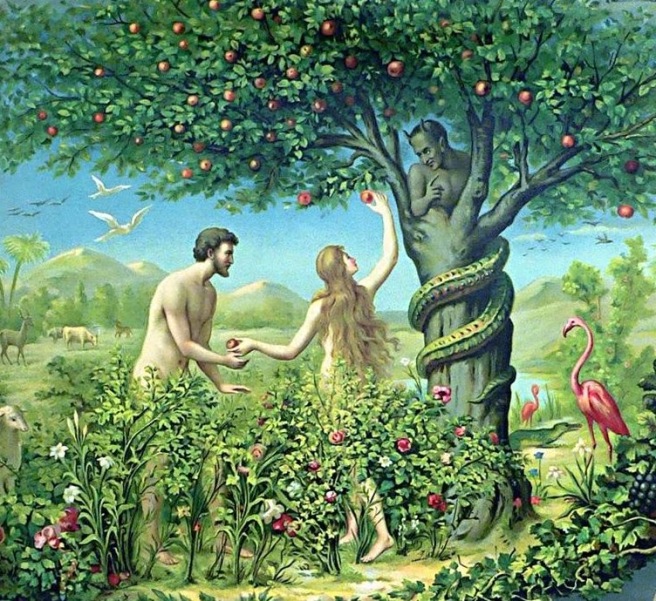
 Satan drew man into sin by telling a lie. It is a lie that not only worked then, but is still working now. It is not a lie directed only towards those who are already perishing, but it is especially directed towards those who, like Adam, were created, or reborn, in the image of God, and who are called the "sons of God". Scripture tells us that, if possible, even the elect will be deceived (Mt. 24:24). After all, it does not benefit Satan to deceive those already condemned, but to deceive the sons of God. If the whole world is deceived at the same time, so much the better.
The custom-tailored lie with which Satan chose to deceive Adam questioned the truth of what God had instructed Adam:
"Has God indeed said, "You shall not eat of every tree of the garden?"....Then the serpent said to the woman, "You will not surely die." Gen. 3:1, 4
We may say, "But it was Eve who was deceived." This is true, but Adam was recorded as being present every step of the way, and consenting (Gen. 3:6). Being present at the scene at the time, if Adam had not also been deceived, he would have stopped his wife from partaking of a death sentence, and he certainly would not have also partaken himself: "She also gave to her husband with her, and he ate."
As devastating as the lie has proven to be, there is a story behind the lie. The lie with which Satan chose to lure Adam was not chosen at random. Satan perceived a weakness in Adam, and custom-tailored his lie to successfully exploit the weakness. The weakness did not die with Adam, the son of God. The weakness, like the lie, persists today even regarding each of us, the sons of God through Christ. What did Satan see in the man that led this cunning, wily creature to choose the lie that he chose? It is important for us to know for ourselves.
We cannot say that Adam didn't know the Word of God. He was told the Word before Eve was created (see Gen. 2:15-18). Not only did he know it, but he even overemphasized the wording and danger of it, according to Eve's understanding (Gen. 3:3).
So, how did Satan know that Adam would choose to ignore the Word of God? Adam was given two other instructions by God even before the command regarding the Tree of the Knowledge of Good and Evil. We tend to overlook these two commands, thinking we understand what they involved by the common English words used to describe them. However, the two preceding commands are extremely important, and anything but common, in the Hebrew language. God "took" (take away, carry off, carry away) the man He had created, and "put" (to rest, give rest to, make quiet, to cause to rest, to be granted rest, to pacify) him in the Garden (enclosed, fenced garden, to defend, cover, surround, to hedge about, protect) of Eden (pleasure, delight, luxury, dainty, finery, delicate, to be soft or pleasant, to conduct oneself softly), and then instructed him. In the commands from God, Adam was told to dress ("abad"- servant, to work, to make oneself a servant, bond-servant, enslave, worshipper) and to keep ("shamar"- to be on one's guard, to keep, guard, observe, give heed, watch, watchman, protect, save life, preserve, reserve, beware, pay heed) the garden (Gen. 2:15).
As we will see later, these same commands were also the understanding of the Son of God, Jesus, and He fulfilled much of His Messianic purpose around them. When the Apostle Paul referred to himself as a "slave" or "bond-servant" of Christ (Rom. 1:1, Phil. 1:1, Titus 1:1), he was referring to "abad". We can know for sure that Adam neglected these first two commands, because of what occurred afterwards. Satan, in the form of a serpent, was allowed to come into the garden by Adam, and challenge the Word of God. Even before Satan's lie, Adam had failed to "shamar" - to protect and preserve. He failed as a watchman. He failed to beware, letting his guard down. When Satan began to challenge the truth of the Word that God had given the man, Adam failed as an "abad" worshipper and bond-servant, who should have immediately defended His Father's truth. Satan had seen by these failures that Adam could be successfully challenged in the commands he had been given by God.
Knowing the Word is a necessary thing. However, Adam's weakness was a weakness in character, as much, if not more, than a lack of Word knowledge, and Satan was able to overcome him. It is the same for us today. We strive to know the scriptures, but if we are not transformed by them in nature and character, we also can be easily deceived:
"And do not be conformed (to the same pattern) to this world, but be transformed (change into another form, transfigure) by the renewing (renovation, complete change for the better)of your mind (understanding, reason, thoughts, feelings, purposes, desires, the capacity for spiritual truth, perceiving divine things, considering and judging soberly, recognizing goodness and hating evil), that you may prove what is that good and acceptable and perfect will of God." Rom. 12:2
Jesus was also tempted in the wilderness by Satan, as Satan again tried to twist, turn, and challenge a Son (Mt. 4:6) with the Word of God. As we see from His responses to that temptation, Jesus overcame the temptation with a faithful knowledge of the Word. However, every response He gave to the temptations also expressed His obedience in character to the abad and shamar commands of God to a Son (Mt. 4:4, 7,10).
Jesus viewed Himself as an "abad" servant to His Father, and He was always discerning and determined to keep, or "shamar", and preserve what had been given into His care:
"For I have come down from heaven, not to do My own will, but the will of Him who sent Me. This is the will of the Father who sent Me, that of all He has given Me, I should lose nothing, but should raise it up at the last day." Jn. 6:38-39
"While I was with them in the world, I kept them in Your name. Those whom You gave Me, I have kept; and none of them is lost except the son of perdition, that the Scripture might be fulfilled." Jn. 17:12, 18:9
This is what it means to be a Son. This is what it means to be transformed by the abad and shamar of the Word. This is also our challenge. We must also be abad servants, being the shamar the Father has ordained us to be. Unfortunately, the prevailing sentiment of our time, and of this world is, "It's all about me." It seems that by the manner in which Adam so quickly accepted the lie that God was withholding good things to which Adam felt entitled (Gen. 3:5), he showed that he believed this philosophy of the world also. The lie of Satan played right into Adam's already revealed heart of resentment and rebellion towards his God Who had saved him out of the dust of the world, created him as His son, carried him away from danger, and set him in a protected place of restful delight.
The lie is still around, and the same weak character of Adam is still drawn to it. However, we have been called to abad and shamar.
Our Father has called us to be sons of God.
Satan drew man into sin by telling a lie. It is a lie that not only worked then, but is still working now. It is not a lie directed only towards those who are already perishing, but it is especially directed towards those who, like Adam, were created, or reborn, in the image of God, and who are called the "sons of God". Scripture tells us that, if possible, even the elect will be deceived (Mt. 24:24). After all, it does not benefit Satan to deceive those already condemned, but to deceive the sons of God. If the whole world is deceived at the same time, so much the better.
The custom-tailored lie with which Satan chose to deceive Adam questioned the truth of what God had instructed Adam:
"Has God indeed said, "You shall not eat of every tree of the garden?"....Then the serpent said to the woman, "You will not surely die." Gen. 3:1, 4
We may say, "But it was Eve who was deceived." This is true, but Adam was recorded as being present every step of the way, and consenting (Gen. 3:6). Being present at the scene at the time, if Adam had not also been deceived, he would have stopped his wife from partaking of a death sentence, and he certainly would not have also partaken himself: "She also gave to her husband with her, and he ate."
As devastating as the lie has proven to be, there is a story behind the lie. The lie with which Satan chose to lure Adam was not chosen at random. Satan perceived a weakness in Adam, and custom-tailored his lie to successfully exploit the weakness. The weakness did not die with Adam, the son of God. The weakness, like the lie, persists today even regarding each of us, the sons of God through Christ. What did Satan see in the man that led this cunning, wily creature to choose the lie that he chose? It is important for us to know for ourselves.
We cannot say that Adam didn't know the Word of God. He was told the Word before Eve was created (see Gen. 2:15-18). Not only did he know it, but he even overemphasized the wording and danger of it, according to Eve's understanding (Gen. 3:3).
So, how did Satan know that Adam would choose to ignore the Word of God? Adam was given two other instructions by God even before the command regarding the Tree of the Knowledge of Good and Evil. We tend to overlook these two commands, thinking we understand what they involved by the common English words used to describe them. However, the two preceding commands are extremely important, and anything but common, in the Hebrew language. God "took" (take away, carry off, carry away) the man He had created, and "put" (to rest, give rest to, make quiet, to cause to rest, to be granted rest, to pacify) him in the Garden (enclosed, fenced garden, to defend, cover, surround, to hedge about, protect) of Eden (pleasure, delight, luxury, dainty, finery, delicate, to be soft or pleasant, to conduct oneself softly), and then instructed him. In the commands from God, Adam was told to dress ("abad"- servant, to work, to make oneself a servant, bond-servant, enslave, worshipper) and to keep ("shamar"- to be on one's guard, to keep, guard, observe, give heed, watch, watchman, protect, save life, preserve, reserve, beware, pay heed) the garden (Gen. 2:15).
As we will see later, these same commands were also the understanding of the Son of God, Jesus, and He fulfilled much of His Messianic purpose around them. When the Apostle Paul referred to himself as a "slave" or "bond-servant" of Christ (Rom. 1:1, Phil. 1:1, Titus 1:1), he was referring to "abad". We can know for sure that Adam neglected these first two commands, because of what occurred afterwards. Satan, in the form of a serpent, was allowed to come into the garden by Adam, and challenge the Word of God. Even before Satan's lie, Adam had failed to "shamar" - to protect and preserve. He failed as a watchman. He failed to beware, letting his guard down. When Satan began to challenge the truth of the Word that God had given the man, Adam failed as an "abad" worshipper and bond-servant, who should have immediately defended His Father's truth. Satan had seen by these failures that Adam could be successfully challenged in the commands he had been given by God.
Knowing the Word is a necessary thing. However, Adam's weakness was a weakness in character, as much, if not more, than a lack of Word knowledge, and Satan was able to overcome him. It is the same for us today. We strive to know the scriptures, but if we are not transformed by them in nature and character, we also can be easily deceived:
"And do not be conformed (to the same pattern) to this world, but be transformed (change into another form, transfigure) by the renewing (renovation, complete change for the better)of your mind (understanding, reason, thoughts, feelings, purposes, desires, the capacity for spiritual truth, perceiving divine things, considering and judging soberly, recognizing goodness and hating evil), that you may prove what is that good and acceptable and perfect will of God." Rom. 12:2
Jesus was also tempted in the wilderness by Satan, as Satan again tried to twist, turn, and challenge a Son (Mt. 4:6) with the Word of God. As we see from His responses to that temptation, Jesus overcame the temptation with a faithful knowledge of the Word. However, every response He gave to the temptations also expressed His obedience in character to the abad and shamar commands of God to a Son (Mt. 4:4, 7,10).
Jesus viewed Himself as an "abad" servant to His Father, and He was always discerning and determined to keep, or "shamar", and preserve what had been given into His care:
"For I have come down from heaven, not to do My own will, but the will of Him who sent Me. This is the will of the Father who sent Me, that of all He has given Me, I should lose nothing, but should raise it up at the last day." Jn. 6:38-39
"While I was with them in the world, I kept them in Your name. Those whom You gave Me, I have kept; and none of them is lost except the son of perdition, that the Scripture might be fulfilled." Jn. 17:12, 18:9
This is what it means to be a Son. This is what it means to be transformed by the abad and shamar of the Word. This is also our challenge. We must also be abad servants, being the shamar the Father has ordained us to be. Unfortunately, the prevailing sentiment of our time, and of this world is, "It's all about me." It seems that by the manner in which Adam so quickly accepted the lie that God was withholding good things to which Adam felt entitled (Gen. 3:5), he showed that he believed this philosophy of the world also. The lie of Satan played right into Adam's already revealed heart of resentment and rebellion towards his God Who had saved him out of the dust of the world, created him as His son, carried him away from danger, and set him in a protected place of restful delight.
The lie is still around, and the same weak character of Adam is still drawn to it. However, we have been called to abad and shamar.
Our Father has called us to be sons of God.
Man lives in the confines of time, but while God appoints times, He is not confined to time. All of our perceptions, even about most of scripture, are built around a measured past, present, and future, but God is not limited in this same way.
As I read the Word, however, sometimes I get the feeling that I am being shown glimpses of an eternity beyond the yesterday, today and tomorrow timeframe that we automatically relate to scripture. An example of this occurred during my reading of the following verses:
"Save me, O God! For the waters have come up to my neck (soul). I sink in deep mire, where there is no standing; I have come into deep waters, where the floods overflow me. I am weary with my crying; my throat is dry; my eyes fail while I wait for my God...But as for me, my prayer is to You, O LORD, in the acceptable time; O God in the multitude of Your mercy, hear me in the truth of Your salvation. Deliver me out of the mire, and let me not sink; let me be delivered from those who hate me, and out of the deep waters. Let not the floodwater overflow me, nor let the deep swallow me up; and let not the pit shut its mouth on me....Draw near to my soul and redeem it...My soul waits for the LORD more than those who watch for the morning- yes, more than those who watch for the morning...I waited patiently for the LORD; And He inclined to me, and heard my cry. He also brought me up (rise, depart, spring up) out of a horrible (noise, tumult, like a house crashing down, roar, destruction, waste, desolate, be in ruins, to cause to be desolated) pit (well, cistern, dungeon, lowest sepulcher of stone-root meaning: declare, make plain, letters on a tablet), out of the miry (mud, dregs of wine) clay (damp dirt, root meaning includes: demon, dirt to be swept away, destruction as being swept clean) , and set my feet upon a rock (a fortress, a refuge, a stronghold of security), and established my steps (follow the footsteps of God, go straight, be happy, be blessed, prosper)." Ps. 69:2, 13-15, 18, Ps. 130:6, Ps. 40:1-2
As I read these verses, I strongly felt that these words of David's could have been spoken by Adam to God in the midst of a desolated, empty, void that was in the beginning (Gen. 1:2) before the work of creation began. After reading the verses above, does anyone else feel that way?
I began to picture God, having heard Adam's cry, pushing back darkness, and speaking light, establishing mornings of hope and new mercies where there had been no mornings. We know from the Word that God established these mornings even before the sun was created (Gen. 1:5, 14-18). For whose benefit did God break out these supernatural mornings? Perhaps He did so in answer to a soul crying to Him from an abysmal, dark emptiness. The message of hope that these mornings would carry to such a soul would be, "I hear you. I'm coming. I will save you." God divided and restrained flooding waters until the dry land appeared. Later, God formed the man and blew His breath into the man's nostrils, and man became a living soul. The term "living" also includes the idea of quickening, reviving, repairing or restoring life. God then fastened a garden (enclosure, root meaning: to defend, to cover, surround, protect, hedge about) to the earth, and placed man in it to provide him with protection and security. This coincides in meaning with what David said, "He set my feet upon a rock".
This impression of God's rescue of Adam that I had while reading these verses from the Psalms would, if accurate, make the account of Adam's subsequent fall even more pathetic. God re-formed and recreated out of vast void and desolation to answer the cry of Adam's soul, yet Adam rejected His will after he was rescued, revived and safe. This similar falling away could also apply to many believers as well as we choose our will over His.
You may say that I am taking a giant leap from scripture into interpretation or impression, and I agree that I cannot prove my impression with specific scriptures. However, I can prove a scriptural precept and foundation which could include such a scenario. According to scripture, a spiritual place of foreknowledge exists in God that is more profound than even Einstein's physics of time and space. If you will bear with me a little further, I promise I will establish this foundation, and it is that foundation in truth that is most important, rather than personal "impressions":
-David is not just a psalmist, but a prophetic and Messianic messenger. One thousand years before the birth of Christ, David revealed the words that Christ would speak (Psalm 22), and many events that that would relate directly to Christ. If David had an intimate spiritual knowledge of the Last Adam (1 Cor. 15:45, Rom. 5:14) before He became flesh, why couldn't David have intimate spiritual knowledge pertaining to the First Adam? Both Adams were connected to each other as "types" (figure, image: see Gen. 1:26, root meaning: wound, beat, smite, strike). Similarly, scripture also calls Adam "the son of God" (Lk. 3:38).
Is it possible for God to know a person before they are physically born or created? Absolutely:
- David wrote that God knew him before he was born: "My frame was not hidden from You, when I was made in secret, and skilfully wrought in the lowest parts of the earth. Your eyes saw my substance, being yet unformed. And in your book they all were written, the days fashioned for me, when as yet there were none of them." Psa. 139:15-16
-God knew Jacob, and his descendants, all of Israel, before Jacob was born (Isa. 44:2, 24).
- The prophet Jeremiah was known by God before he was born, even before the womb: "Before I formed you in the womb I knew you; before you were born, I sanctified you; I ordained you a prophet to the nations." Jer. 1:5
-The priesthood tribe of Levi was known by God, and offered tithes to God, generations before Levi was actually born, while his generation was still in his ancestor Abraham's loins (Heb. 7:9-10).
- WE were known before we were born, even before the creation- not only known, but called to salvation:
"...just as He chose us in Him before the foundation of the world, that we should be holy and without blame before Him in love...being predestined according to the purpose of Him who works all things according to the counsel of His will.." Eph.1:4, 11(also see Rev. 13:8)
"For whom He foreknew, He also predestined to be conformed to the image of His Son that He might be the firstborn among many brethren. Moreover, whom He predestined He also called; whom He called, these He also justified; and whom He justified, these He also glorified." Rom. 8:29-30. This is also why scripture can say that we were already crucified, buried, and raised with Christ, when He was crucified, buried, raised and living again (Rom. 6:3-8).
"...elect according to the foreknowledge of God the Father, in sanctification of the Spirit, for obedience and sprinkling of the blood of Jesus Christ." 1 Pet. 1:2
Regarding my impressions of Adam and his pre-creation cries to God as being the impetus of the startling creative work of God let me pose the question:
If God knew David, Jeremiah, Levi, and all of Israel before they were born, and knew and saved us even before the foundation of the world was established (and we were in Adam), why could He not also have known, heard, revived, and rescued Adam in the same manner?
I understand if you do not think that my impression concerning Adam is scripturally accurate, nor is it right for anyone to hang their faith upon any "impression", but upon the Word of God only. The speculation regarding Adam is not even the main point of this entry, which is the foreknowledge that God possesses, especially concerning our lives and purpose. This view of Adam as the impetus of the creation work of God that we read in Gen. 1 was only valuable because of the impact it had upon me, and the impression it made on me, to start me on a search that taught me something about the awesome magnitude of God our Father, and the depth of His omniscient, omnipresent, omnipotent, power and knowledge in eternity. It helped to illustrate for me His driven, unconquerable love to rescue and save us from before the foundation of the world. Its personal message to me is the assurance that He knew me in eternity and heard my cry, and moved heaven and earth to save me. I hope it has a similar impact for you.
Our Father knows and declares the end from the beginning.
"Morning Has Broken"
https://www.youtube.com/watch?v=3Rifby1tVE8
 Often times, when trying to understand who we are in Christ, we may think back to Adam, and the great authority and purpose of that man, and potentially all mankind.
However, I have to ask myself: Is this what Jesus accomplished-to bring us back to Adam- to "restore" us back to the original, to Adam before the fall? However, I'm seeing something else here. I would like to study it through.
Adam was a "type":
"Nevertheless death reigned from Adam to Moses, even over those who had not sinned according to the likeness of the transgression of Adam, who was a type of Him who was to come." Rom. 5:14
According to the above scripture, Adam was a "type" of Christ because of his role as a progenitor- all man who followed him carried the same consequence of Adam's actions, in this case death, regardless of whether they committed the same sin as Adam. Like Christ, Adam is a progenitor of a kind-in that case: mankind. Following our fleshly progenitor, man became sinful, dying mankind.
Likewise, following that same "type", Jesus is a progenitor of a kind. All who "follow" after Him, also follow what Christ created, part of which was life from the dead, but it goes beyond that.
So if it was not Jesus' intention to restore us back to Adam's stature and purpose, what then can I understand about how He was a progenitor to me? This scripture helps me:
"...if One died for all, then all died; and He died for all, that those who live should live no longer for themselves, but for Him who died for them and rose again. Therefore, from now on, we regard no one according to the flesh. Even though we have known Christ according to the flesh, yet now we know Him thus no longer, THEREFORE, IF ANYONE IS IN CHRIST, HE IS A NEW CREATION; OLD THINGS HAVE PASSED AWAY; BEHOLD ALL THINGS HAVE BECOME NEW..." 2 Cor. 5:14-17
Also-
"For in Christ Jesus neither circumcision nor uncircumcision avails anything, but a new creation." Gal. 6:15
What does the term "new" mean in the above verses? The Greek word, kainos means "of a new kind, unprecedented, novel, uncommon, unheard of". We, following His precedent, have become a new creature. Even as we knew Him to be on earth in the flesh of man (like Adam), we cannot know Him as that now. He became something new as well, unknown before this, and unheard of, and we also, following our progenitor, are this new creation.
I would often wonder how it was fair that I am born with a nature to sin, and in the process of dying, just because Adam sinned. Now I see the powerful precedent of his role as a "type", or progenitor. It was so God could send another progenitor. This time, a progenitor to a new creation, and of life forever more. The progenitor concept allows me to become, even thousands of years later, what Christ established. God is brilliant!!
It would seem that this "new creature" fits right into God's plan. According to His word, God does not intend to restore creation to a former state, but rather:
"Do not remember the former things, nor consider the things of old. Behold I will do a new thing, now it shall spring forth; shall you not know it?...
For behold, I create new heavens and a new earth; and the former shall not be remembered or come to mind (come upon the heart). But be glad and rejoice forever in what I create; for behold I create Jerusalem as a rejoicing, and her people a joy." Isa. 43:18-19, 65:17-18
Notice the LORD doesn't say "I will create". This "create" is present tense.
So, what exactly am I?
Jesus' disciples didn't quite know either. They were given only small glimpses as they encountered Jesus after His resurrection. We also have this scripture that helps:
"Beloved, now we are children (sons) of God; and it has not yet been revealed what we shall be, but we know that when He is revealed, we shall be like Him, for we shall see Him as He is." 1 Jn. 3:2
While we may not have a full picture in of ourselves as that new creation, we do have Christ's directives to us as to what we are to be doing now (Mt. 28:18-20, Mk. 16:15-20, Lk. 24:44-49, Acts 1:8).
It is of incredible benefit to look backwards through scripture. We learn many, many vital things. It is all truth and edifying (2 Tim. 3:16-17). However, it is also prophetic, telling us of things to come. There was a TV show entitled "The New Old Christine". We, however, have not become "the new, old Adam", but rather something that never existed before, but now exists through Christ, the progenitor of a new creation.
Our Father made us a NEW creation through Christ.
"We Will See Him As He Is"
https://www.youtube.com/watch?v=KcCB-T8NeXI
Often times, when trying to understand who we are in Christ, we may think back to Adam, and the great authority and purpose of that man, and potentially all mankind.
However, I have to ask myself: Is this what Jesus accomplished-to bring us back to Adam- to "restore" us back to the original, to Adam before the fall? However, I'm seeing something else here. I would like to study it through.
Adam was a "type":
"Nevertheless death reigned from Adam to Moses, even over those who had not sinned according to the likeness of the transgression of Adam, who was a type of Him who was to come." Rom. 5:14
According to the above scripture, Adam was a "type" of Christ because of his role as a progenitor- all man who followed him carried the same consequence of Adam's actions, in this case death, regardless of whether they committed the same sin as Adam. Like Christ, Adam is a progenitor of a kind-in that case: mankind. Following our fleshly progenitor, man became sinful, dying mankind.
Likewise, following that same "type", Jesus is a progenitor of a kind. All who "follow" after Him, also follow what Christ created, part of which was life from the dead, but it goes beyond that.
So if it was not Jesus' intention to restore us back to Adam's stature and purpose, what then can I understand about how He was a progenitor to me? This scripture helps me:
"...if One died for all, then all died; and He died for all, that those who live should live no longer for themselves, but for Him who died for them and rose again. Therefore, from now on, we regard no one according to the flesh. Even though we have known Christ according to the flesh, yet now we know Him thus no longer, THEREFORE, IF ANYONE IS IN CHRIST, HE IS A NEW CREATION; OLD THINGS HAVE PASSED AWAY; BEHOLD ALL THINGS HAVE BECOME NEW..." 2 Cor. 5:14-17
Also-
"For in Christ Jesus neither circumcision nor uncircumcision avails anything, but a new creation." Gal. 6:15
What does the term "new" mean in the above verses? The Greek word, kainos means "of a new kind, unprecedented, novel, uncommon, unheard of". We, following His precedent, have become a new creature. Even as we knew Him to be on earth in the flesh of man (like Adam), we cannot know Him as that now. He became something new as well, unknown before this, and unheard of, and we also, following our progenitor, are this new creation.
I would often wonder how it was fair that I am born with a nature to sin, and in the process of dying, just because Adam sinned. Now I see the powerful precedent of his role as a "type", or progenitor. It was so God could send another progenitor. This time, a progenitor to a new creation, and of life forever more. The progenitor concept allows me to become, even thousands of years later, what Christ established. God is brilliant!!
It would seem that this "new creature" fits right into God's plan. According to His word, God does not intend to restore creation to a former state, but rather:
"Do not remember the former things, nor consider the things of old. Behold I will do a new thing, now it shall spring forth; shall you not know it?...
For behold, I create new heavens and a new earth; and the former shall not be remembered or come to mind (come upon the heart). But be glad and rejoice forever in what I create; for behold I create Jerusalem as a rejoicing, and her people a joy." Isa. 43:18-19, 65:17-18
Notice the LORD doesn't say "I will create". This "create" is present tense.
So, what exactly am I?
Jesus' disciples didn't quite know either. They were given only small glimpses as they encountered Jesus after His resurrection. We also have this scripture that helps:
"Beloved, now we are children (sons) of God; and it has not yet been revealed what we shall be, but we know that when He is revealed, we shall be like Him, for we shall see Him as He is." 1 Jn. 3:2
While we may not have a full picture in of ourselves as that new creation, we do have Christ's directives to us as to what we are to be doing now (Mt. 28:18-20, Mk. 16:15-20, Lk. 24:44-49, Acts 1:8).
It is of incredible benefit to look backwards through scripture. We learn many, many vital things. It is all truth and edifying (2 Tim. 3:16-17). However, it is also prophetic, telling us of things to come. There was a TV show entitled "The New Old Christine". We, however, have not become "the new, old Adam", but rather something that never existed before, but now exists through Christ, the progenitor of a new creation.
Our Father made us a NEW creation through Christ.
"We Will See Him As He Is"
https://www.youtube.com/watch?v=KcCB-T8NeXI
Man was a wondrous creation. There were three stages to his creation by Elohim, the Ruler, the Judge, the plurality of God.
Stage 1 was "Adam":
"Then God said, "Let Us make man (adam) in Our image (resemblance, representative figure), according to Our likeness (similitude, like manner, to be like, comparable); let them have dominion (rule, reign, prevail against, tread down as a wine press)....over all the earth, and over every creeping thing that creeps on the earth." Gen 1:26
At this point, in Stage 1, the man is referred to as adam. The Hebrew word refers to a reddish complexion. The root word, dam, means blood. The first stage is the blood.
This man was created to be a representative figure of God, with like manner, even comparable manner, and his purpose was to rule and prevail against.
Stage 2 was "Nefesh":
"And the LORD God formed man of the dust of the ground, and breathed (blow, kindle, give up life) into his nostrils the breath (spirit) of life, and man became a living soul (nefesh)." Gen. 2:7
First of all, God's name has changed for this stage of the creation of man. He is LORD God. His name reflects that He is existing, and He brings forth, and sustains or continues all existence.
As the breath left LORD God and entered into man, man received the life force, the spirit and the soul (heart, mind, will) of God, and became a soul (nefesh) himself. "Nefesh" also means life, to refresh, take rest, cease from working. LORD God gave up a portion of His life breath into the man He created.
Stage 3 was "Iysh":
The iysh stage of man came into being upon man's marriage:
"And Adam said, "This is now bone of my bones, and flesh of my flesh; She shall be called "Woman" (iyshah), because she was taken of man (iysh)."
Therefore a man shall leave his father and mother and be joined to his wife, and they shall become one (echad) flesh." Gen. 2:23-24
The Hebrew meaning of iysh (man) here is husband, servant, champion, great man, high-degree. The root includes a plurality- mankind, or a part of a greater number.
So this man, created from the blood, a representative of God, comparable to God, filled with LORD God's own breath, soul and spirit, was meant to be both a servant, and a champion, containing the great number of others called "mankind".
However, this man, who was created to be a champion, instead became a co-conspirator with a creature who only wanted to see man die. It is almost too pitiful to bear.
With great and eternal thanks for the mercy and loving kindness of the LORD God, our Father, the story doesn't end there. Out of the iysh-man's future multitudes, and from the work of the Holy Spirit, LORD God redeemed us through His only begotten Son, Jesus, and re-created us anew: Ber-i-yah. Let us look at this new creation:
Stage 1- The Blood:
As with Adam, our Father started this new creation with the blood, in this case, the blood of Christ:
"For this is My blood of the new covenant, which is shed for many for the remission of sins."
Mt. 26:28
"But now in Christ Jesus you who once were far off have been brought near by the blood of Christ." Eph. 2:13
Stage 2-The Breath:
As LORD God breathed into Adam to create Nefesh, a living soul, we also have received the breath of the Holy Spirit as Christ did the new work in us:
"And when He (Jesus) had said this, He breathed on them and said to them, "Receive the Holy Spirit." Jn. 20:22
Stage 3- The Marriage:
"Let us be glad and rejoice and give Him glory, for the marriage of the Lamb has come, and His wife has made herself ready." Rev. 19:7
When Adam recognized his wife, and God defined marriage, man became "iysh", champion.
We also have been called into a marriage with Christ. While we are not the champion, we have the "Champion" in us:
"To them God willed to make known what are the riches of the glory of this mystery among the Gentiles: which is Christ in you, the hope of glory." Col. 1:27
"You are of God, little children, and have overcome them, because He who is in you is greater than he who is in the world." 1 Jn. 4:4
As Adam became aware of his plurality upon marriage, we also are plural in nature. Not only, does the plurality of the Trinity dwell in us, and we in them, but we are a city on a hill (Mt. 5:14), having many members(1 Cor. 12:20), a New City come down from heaven, prepared as a bride adorned for her husband, as the Bride, the Lamb's wife (Rev. 21:2,9-10). As this city, we contain the Tabernacle of God (Rev. 21:3), and the throne of God and the Lamb (Rev. 21:5, 22:1), the light of the Lamb and the glory of God (Rev. 21:13, 22:5), the river of life flowing through us, and the healing of the nations contained within this city that is the Bride (Rev.22:1-2). This New City, created by marriage to the Lamb, is the home of countless numbers:
"(You) have redeemed us to God by Your blood out of every tribe and tongue and people and nation, and have made us kings and priests to our God; and we shall reign on the earth." Rev. 5:9-10
Adam attained a greatness of number, stature and purpose when he married and became "iysh". We, also have attained a great destiny through our marriage to the Lamb.
We have been created again, miraculously, and anew, by the atoning work of Jesus.
That creature in Gen 2, who only wanted to see man die? He's still around (Mt. 10:28, Jn. 10:10).
Let's not make the same mistake twice.
Our Father has made a new creation, Ber-i-yah.
"A New Creation"
https://www.youtube.com/watch?v=4DhpPJdd9vo
