Showing posts with label testimony. Show all posts

Friday, January 30, 2026

MyTestimony

       "And He (Jesus) said to them, 'Go into all the world and preach the gospel to every creature. He who believes and is baptized will be saved; but he who does not believe will be condemned. And these signs shall follow those who believe: In My name they will cast out demons; they will speak with new tongues; they will take up serpents (ophis - snake, serpent, sly and cunning deception, artful and malicious person like Satan, the devil, hypocrite); and if they drink anything deadly, it will by no means hurt them; they will lay hands on the sick, and they will recover." (Mk. 16:15-18).

     This week's Sabbath reading portion is titled B'shallach, which means "When he let go." This title is taken from the first verse of the reading portion, Exodus 13:17: "Then it came to pass, when Pharaoh had let (*aleph-tav/Alpha and Omega)-the-people go (shawlakh - send forth, send away, send out, loose, cast out, stretch out, shoot forth as a weapon, set free, let go, let depart, send/drive to pasture, send a messenger), that God did not lead them by way of the land of the Philistines (pelisti/palas - descendants of the Egyptians who migrated to the western seacoast of Canaan, strangers/to roll in ashes and dust, to wallow, to dig a hole, to roll oneself), although that was near; for God said, 'Lest perhaps (*aleph-tav/Alpha and Omega)-the-people change their minds when they see war (milhama/laham - war, battle, fight, warriors, warfare/devour or eat as food, make war, overcome, prevail, to fight, to battle), and return to Egypt."

     After the last plague of death to the first born of Egypt, Pharaoh, the king of Egypt, let the people of God go (shawlakh, see above) . The LORD led His people, not by the nearest route which would take them through the land of the Philistines but led them by the longer route through the Red Sea wilderness. He did not think that they had the fortitude to face battle with the Philistines yet. The Israelites would not face the Philistines until later in time.

     After the Israelites left Egypt, they began to face continual challenges. Pharaoh decided to pursue them and trapped them by the Red Sea. They were terrified. They cried out to the LORD and said to Moses: "Because there were no graves in Egypt, have you taken us away to die in the wilderness?...Is this not the word that we told you in Egypt, saying, 'Let us alone that we may serve the Egyptians'? For it would have been better for us to serve the Egyptians than that we should die in the wilderness." (Ex. 14:11-12). At that point, the LORD delivered the Israelites from the Egyptian army by dividing the waters of the Red Sea so that they could cross to the other side: "So the children of Israel went into the midst of the sea on the dry ground, and the waters were a wall to them on their right hand and on their left." (v. 22, see also Ps. 78:13). The sea water was so thoroughly removed that the ground underneath the waters was not muddy but dry.

    As the Israelites were trapped before the Red Sea, Moses had promised them: "Do not be afraid. Stand still and see (*aleph-tav/Alpha and Omega)-the-salvation (yesua - Jesus' Hebrew name, salvation, help, deliverance, welfare, victory) of the LORD, which He will accomplish for you today....". (Ex. 14:13). After the LORD parted the waters of the Red Sea to allow the Israelites to pass through it and then released the waters of the sea in order to drown the pursuing Egyptian army, Moses and the Israelites celebrated this great miracle with a joyous song. Part of this song included: "The LORD is my strength and song, and He has become my salvation (yesua - see above); He is my God, [and I will prepare Him a habitation (nava - abide, adorn, beautify, celebrate with praise)]/and I will praise Him; my father's God, and I will exalt Him." (Ex. 15:2).

     Immediately after this celebration, however, (*aleph-tav/Alopha and Omega)-Israel came to a place of undrinkable, bitter waters, and they complained. The LORD made the bitter waters sweet by having Moses cast a certain tree ('es - tree, gallows, carpenter) into the waters. At this place, the LORD revealed His name, "I AM the LORD who heals you." (see Ex. 15:22-26).

     Then the (*aleph-tav/Alpha and Omega)-whole-assembly began to make (*aleph-tav/Alpha and Omega)-murmurings against Moses and the LORD over not having meat and bread. Then the LORD heard their (*aleph-tav/Alpha and Omega) murmurings and sent them quails for meat in the evenings and bread from heaven in the mornings. (Ex. 16:1-13). Their "murmurings" have the written Hebrew *aleph-tav before them because the murmurings were against the Messiah/Christ.  Generations later, Jesus would solve this mystery by comparing Himself to the manna bread in the wilderness, calling Himself the Bread from heaven of eternal life as the Israelites of His day murmured and complained against Him, as specifically worded in the verses from The Gospel of John. (see Jn. 6:41-43, 48-51). The exact repetition of the wording between Exodus 16 and John 6 is no coincidence.

     As believers in Jesus Messiah/Christ, when we murmur and complain about anything, who are we really murmuring against but the One who is the Lord of our lives, Jesus? Murmurings and complaints become our testimony to others of who Jesus is, or is not, in our lives.

     Psalm 78 is another portion from this week's B'shallach, "When he let go" Sabbath reading. This psalm recounts the kindness and miracles that the LORD showed to Israel even though they continually rebelled against Him and complained against Him.

     The psalmist, Asaph ('asap - "gatherer", "collector", assemble together, to gather and take away, gather the harvest, to take in, to receive into), wrote of the wonders that God did for His people to deliver them from slavery in Egypt, and afterwards, to give them the provision that they needed in the wilderness. However, Asaph wrote, His people were stubborn and rebellious and "whose spirit was not faithful to (*aleph-tav/Alpha and Omega)-God." (v. 8). The psalmist said that he wrote this psalm as a testimony for future generations: "We will not hide them (referring to the sayings of old from the fathers) from their children, telling to the generation to come the praises of the LORD, and His strength and His wonderful works that He has done. For He established a testimony ('edut/'ed/'ud - testimony, witness, holy rites, revelation, "the Holy Ghost saith"/prince, recorder, emphatically affirming/testify, record, surround, restore, say again and again, affirm solemnly, exhort solemnly, give warning) in Jacob, and appointed a law in Israel...that they should make them known to their children; that the generation to come might know them, the children who would be born, that they may arise (qum - arise, establish, stand, confirm, continue, abide, accomplish, perform, endure, prove) and declare them to their children, that they may set their hope in God, and not forget the works of God, but keep His commandments." (v. 4-7).

     The power contained in the testimony given to Israel praising the wonderful works of God kept generation after generation alive and preserved them through danger, even the danger of their own rebellion, and sorrow. As we see the Hebrew meaning connected to the word "testimony", we can see that it is powerful, inspired and appointed by the Holy Spirit.

      When Pharaoh the king of Egypt let the people go (see B'shallach and shawlakh above), he would be sending them out to encounter an eternal testimony.

     Similarly, in verses from Mark 16 shown at the top of this page, Jesus, the King of Kings, sent His believers out with a testimony, the Gospel, commanding them to take that testimony of His suffering, death, burial and resurrection for the forgiveness of sins and the glory of God, to every creature. It is also an eternal testimony leading the hearer to salvation and eternal life. It is a testimony so powerful that it overcomes Satan, himself: "And they overcame him (referring to the accuser of the brethren, Satan) by the blood of the Lamb and by the word of their testimony, and they did not love their lives to the death." (Rev. 12:11). This testimony contains the power of "salvation, and strength, and the kingdom of our God, and the power of His Christ" (see Rev. 12:10). As the verses from Mark 16 at the top of the page tell us, miracle signs and wonders follow the believers with this testimony in their mouths.

     Rather than the testimony of murmuring and complaining, we have been entrusted with this amazing testimony, the Gospel, not only for our own sakes but for the sake of every creature.

     If you would like to learn more about our testimony, the Gospel of Jesus Christ, you can join my prayer: "Heavenly Father, You have given to us the most amazing and powerful testimony to bring to future generations and to every creature! By the inspiration of the Holy Spirit, Lord, keep this testimony in my heart, mind and mouth, rather than the testimony of murmuring and complaining, which testifies against You. Forgive me, Lord, when my words and testimony have robbed You of glory. Let this testimony that You have given to me glorify the Father, Son, and Holy Spirit always, as well as testifying to life, even eternal life gained for us by Christ. As the song says, "O how marvelous! O how wonderful! Is my Savior's love for me!" These are the wonderful works of God. This is my testimony in Jesus' name. AMEN."

*NOTE: aleph-tav written in Hebrew as אֶת, are the first and last letters of the Hebrew alphabet. The meaning of the two pictographic Hebrew letters can also be interpreted "Adonai (Lord) of the Cross/Covenant". In the New Testament, these letters are translated as Alpha and Omega written as ΑΩ , the first and last letters of the Greek alphabet. These letters are those by which Jesus Christ identifies Himself in the Book of Revelation: see Rev. 1:8Rev. 21:6Rev. 22:13


Friday, July 26, 2024

TribalTestimony


     This week's Sabbath reading portion is titled Pinchas, who was also known as Phineas, and covers Numbers 25 through 27. (*Aleph-tav/Alpha and Omega) Phineas (see written Hebrew of Ex. 6:25) was the grandson of Aaron, and because of his zeal for the LORD, his actions stopped a plague that had killed 24,000 Israelites because they had married Moabite/Midianite women and had joined themselves to the women's false god Ba'al (Num. 25:1-9). The name Phinehas means "mouth of brass, break in pieces the hissing serpent/snake/image of a serpent/fleeing serpent; to command, blow away, break in pieces the enchanter/divination/practice of fortunetelling." This challenge to the LORDSHIP of God over the Israelites came shortly before the allotments for the inheritance of the land were officially established.

     The LORD commanded Moses and Eleazar the priest, the son of Aaron who had died, to take a census of all males over the age of twenty, which are those who were able to go to war. The census was taken by tribe separately, and then added together: "These are those who were numbered of the children of Israel: six hundred and one thousand seven hundred and thirty...Each shall be given its inheritance according to those who were numbered of them. But the (*aleph-tav/Alpha and Omega) land shall be divided by lot; they shall inherit according to the names of the tribes of their fathers. According to the lot their inheritance shall be divided between the larger and the smaller." (Num. 26:51-56). The Israelites had traveled through the wilderness by tribes under separate tribal banners, had encamped in specific tribal formation around the tabernacle, and would occupy the (*aleph-tav/Alpha and Omega) land by tribal groups. The word "tribe" is the Hebrew word matte/nata, meaning "staff, branch, staves, correcting rod, ruling scepter, throwing lance, support of life/stretch out, extend, cause to yield, spread." The "tribe" had to do with the ruling royal scepter and extending authority. 

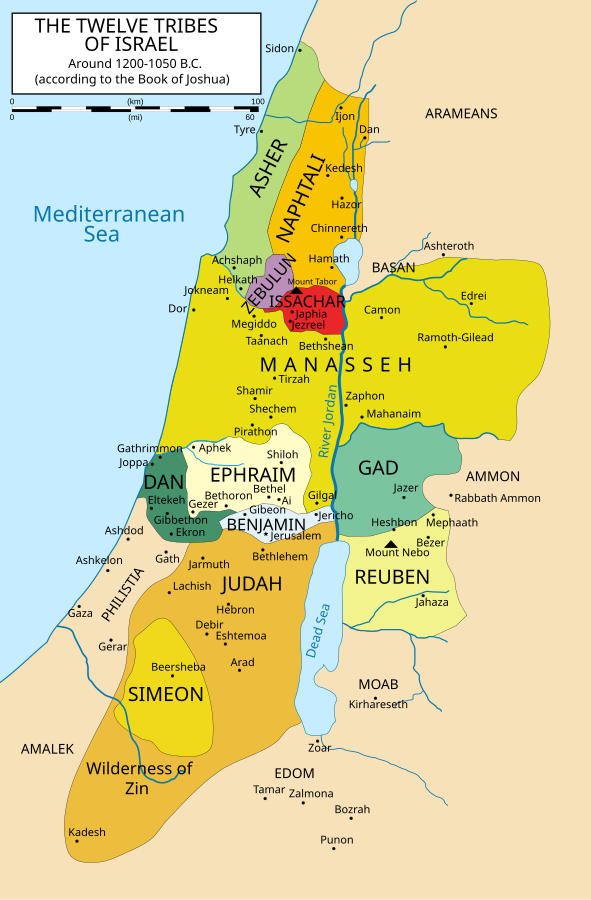
      The map at the top of the page shows the allotment of the land of Canaan to each Israelite tribe according to the result of this final census and the casting of lots. As we can see, the land was not claimed by each individual Israelite as he chose but was settled in tribal units. Within each tribal allotment, the land was further allotted to each of the heads that had descended directly from the tribal patriarch of generations past. We will see a reason for this. Before we do that, however, another reading selection from this Sabbath from Joshua 17, reminds us that the inheritance that would go to the tribe of Manasseh had to be restored of a very important missing part. One of the descendants of Manasseh, Zelophehad, had died in the wilderness, and had only five daughters. The daughters earlier had demanded of Moses that they should be able to inherit their father's future portion of land so that his inheritance would not be lost, saying: "Why should the name of our father be removed (gara - diminish, withdraw, keep back, be restrained) from among his family because he had no son? Give us a possession among our father's brothers." (Num. 26:33, Num. 27:1-4). In verse 11, it is called an (*aleph-tav/Alpha and Omega) inheritance. The LORD told Moses to agree to this request, and inheritance laws were established to reflect this. In Joshua 17:3-6, those five daughters come before Joshua to claim the inheritance that had been promised to them by Moses. Their father's name was preserved within the tribe of Manasseh through his five daughters. His name means "first born" (see also Ex. 13:11-12, Zech. 12:10, Lk. 2:4-7, Rom. 8:28-30, Col. 1:13-18, Rev. 1:4-6). His daughters' names mean "wounded, disease, travail (see Isa. 53:4-5, 11)/ stagger (see Mt. 26:36-39)/ partridge: call, cry out, proclaim, named, invited, preach, summon, bidden, guest, be chosen (see Jn. 7:37-38, Jn. 15:16)/ queen-king, rule and reign (see Ex. 19:5-62 Tim. 2:11-13, Rev. 5:9-10)/ to be pleased with (see Lk. 3:21-22, pleasant land whose city is the seat of the kingdom (see Ps. 16:6, Rev. 21:1-5)." We can see that each descendant's name is important to God, who had agreed that this name should not be lost from the tribe of Manasseh. We can see the identity of the Messiah/Christ Jesus in these names alone. We will see even more of the purpose of God in commanding that the (*aleph-tav/Alpha and Omega) land be settled by tribal identity.

     Keeping in mind the profane idolatrous practices of the inhabitants of Canaan whom the LORD was displacing with the tribes of Israel, the Hebrew meaning of "tribe" being "staves, branches, scepters of ruling, extending, spreading out, causing to yield", becomes very important.  The practices of idolatry by the Canaanites even included human/child sacrifices (see warning: Mt. 19:13-15Mt. 18:5-710). The LORD was casting down false gods, occultic practices and bondages of spiritual darkness with His name and His covenant expressed by the witness of the tribes of His people.

      Isaiah later wrote: "You are My witnesses (ed/ud - witness, evidence, testimony, recorder, prince, commander, legislator/restore, relieve, bear witness, cause to testify, affirm, exhort, enjoin, admonish, charge solemnly, give warning),' says the LORD, 'and My servant whom I have chosen, that you may know and believe Me, and understand that I am He. Before Me there was no God formed, nor shall there be after Me. I, even I, am the LORD, and besides Me there is no savior. I have declared and saved, I have proclaimed, and there was no foreign god among you; therefore you are My witnesses,' says the LORD, 'that I am God." (Isa. 43:10-12). Isaiah also wrote: "Bind up the testimony (te'uda/ud - testimony attestation, precept/ ud - see above), seal (hatam - seal up, affix a seal, marked, lock up, close up - see also Rev. 7:3) the law among my disciples." (Isa. 8:16). Those who are disciples are marked and sealed inwardly and outwardly with the testimony/witness of God's precepts and salvation promises.

     The land of Canaan became covered west to east and north to south with the ruling scepters of the tribes of Israel. These were the tribes who occupied the land, and the witness/testimony found in their names:

Asher - happy, fortunate, to go straight, set right, upright, prosper (Ps. 146:5-7)

Naphtali - wrestling, struggle, twist (Gen. 32:24-30, Eph. 6:12-13)

Manasseh - cause to forget (..."all my toil", Gen. 41:51) (Jer. 31:34Heb. 8:10-13)

Zebulun - exalted habitation, dwell exaltedly, inhabit (Isa. 33:5-6Eph. 2:6-7Jn. 14:2-3)

Issachar - "there is recompense", wages, reward (Isa. 40:10-11Rev. 22:12-14)

Ephraim - "I shall be doubly fruitful", fruitfulness (Jn. 15:4-5)

Gad - troop, invade, attack, overcome, fortune (Mk. 3:27Rev. 12:10-11Rev. 3:12)

Benjamin - "son of the right hand", right side (Rom. 8:34Col. 3:1-3Heb. 12:1-2)

Reuben - "behold a son" (Isa. 9:6-7, Lk. 2:7)

Judah - praised, thanks, confess, shoot arrow (Ps. 34:1-3Lk. 1:67-75)

Simeon - heard, hearing with acceptance, hear, obey, publish, declare (Isa. 52:7Lk. 11:28)

     The witness of the tribes of Israel was against the spiritual powers present in the land and the wicked ways of the Canaanite people of the land which the LORD had promised to Abraham's descendants, and upon which He had set His holy name (Neh. 1:9). The LORD will not allow His (*aleph-tav/Alpha and Omega) holy name to profaned by anyone or anything (Ex. 20:7, Ezek. 36:23-24, Ezek. 39:7) for the sake of His power of salvation, because "Whoever calls upon the name of the LORD shall be saved." (Joel 2:32, Rom. 10:9-13).

     From this land, the spiritual witness of the tribes regarding the LORD God and the Messiah/Christ spread out or extended (see Hebrew word for "tribe" above) throughout the earth. Jesus also said to His disciples after His resurrection: "But you shall receive power when the Holy Spirit has come upon you; and you shall be witnesses to Me in Jerusalem, and in all Judea and Samaria and to the end of the earth." (Acts 1:8).

     From another reading portion from this Sabbath, Joshua, who had led the tribes into the promised land and apportioned the inheritance to each tribe years before, knew that he was soon to die. Understanding the importance of the testimony and witness of the tribes, he gave this solemn warning: "Therefore be very courageous (hazak - strong, strengthened, prevail, be urgent, keep hold of, to tie fast or bind bonds strongly) to keep and to do all that is written in the Book of the Law of Moses, lest you turn aside from it...and lest you go among these nations, these who remain among you. You shall not make mention of the name of their gods...you shall not serve them nor bow down to them, but you shall hold fast to the LORD your God, as you have done to this day. For the LORD has driven out from before you great and strong nations, but...no one has been able to stand against you to this day....Therefore take careful heed to yourselves, that you love the (*aleph-tav/Alpha and Omega) LORD your God. Or else, if...you...cling to the remnant of these nations...and make marriages with them, and go in to them and they to you, know for certain that the LORD your God will no longer drive out these nations from before you. But they shall be snares and traps to you, and scourges on your sides, and thorns in your eyes, until you perish from this good land which the LORD your God has given you." (Josh. 23:6-13).

     It takes strength in the Word of God to resist the urge to adopt and practice the world's ways that defile us and profane the name of the LORD because the pressure and draw is great. Paul wrote that these ungodly strongholds are pulled down when our obedience is fulfilled. (2 Cor. 10:4-6). We have been entrusted with an urgent and important testimony and a witness contained in the new name/character which we have been given by God through Messiah/Christ. (see Isa. 62:1-5, 2 Cor. 5:17-18).

     If you would like to know more about walking out and living our identity purpose, you can pray with me: "Heavenly Father, the tribes of Israel had a witness within them of You, Your Word, Your Messiah/Christ and Your salvation. Lord, by Your Living logos Word Jesus, and Your Holy Spirit, help me to be a living testimony of Your greatness and Your love. For You so loved the world that You gave Your only Son for it, that whoever would believe in Him would not perish but have eternal life. I bless, exalt and magnify Your holy name, the name of My salvation and deliverance. AMEN."

*NOTE: aleph-tav written in Hebrew as אֶת, are the first and last letters of the Hebrew alphabet. The meaning of the two pictographic Hebrew letters can also be interpreted "Adonai (Lord) of the Cross/Covenant". In the New Testament, these letters are translated as Alpha and Omega written as Α Ω , the first and last letters of the Greek alphabet. These letters are those by which Jesus Christ identifies Himself in the Book of Revelation: see Rev. 1:8Rev. 21:6Rev. 22:13.


Friday, July 12, 2024

Ordinance

     Our Sabbath reading portion for this week is titled Chukkot, meaning "Ordinances of", and begins in Numbers Ch. 20. The Hebrew title Chukkot comes from the words hukka/hoq/haqaq which mean "statute, ordinance, limit, law, that which is established or defined/ordinance, bounds, commandments, boundary, decrees/decree, cut out, engrave, inscribe, govern, law giver, cut upon, mark out, cut in stone, a scepter, carve out like a grave or sepulcher in a rock." The ordinances of God are "set in stone" as the meaning of the word in Hebrew describes above. They are immutable (unchanging over time, unable to be changed-see Mal. 3:6, Heb. 13:8) by any natural means. We should keep in mind when considering the ordinances of God that there are two powerful and prophetic precedents that were established before the law was given to Israel from Mt. Sinai through Moses: covenant and grace. Covenant promises kept the LORD from completely wiping out the children of Israel, although they broke His ordinances (Mal. 3:6-7). Noah found grace in the eyes of God even though "all flesh had corrupted their way on the earth" and "every intent of the thoughts of his (man's) heart was only evil continually." (Gen. 6:5-13). However, neither of these two preceding conditions were intended to encourage the breaking of God's ordinances, and that without consequence (Rom. 6:1-215-16). Neither covenant nor grace, however, means that we can continue to sin against the ordinances of God. These ordinances are to become written in our hearts so that we can live them as a testimony of God before men.

     In our Sabbath reading portion, Chukkot, or "Ordinances of", the children of Israel, the whole congregation (eda/ed - appointed meeting/witness, testimony, evidence), were in Kadesh (qades - holy, consecrated to God, consecrated to licentious idolatry) in the Wilderness of Zin (flat, to prick), a desert region. So God has directed His people to this specific place for an appointed meeting, to testify of His ordinances as witnesses. This place, Kadesh, can either be a place of holiness before the LORD or a place for the worship of idols by sexual uncleanness and soul-demeaning and soul-destroying perversion according to the meaning of the name. Imagine the spirits of wickedness that were to be found in this place, but God's assembly had been specifically brought to this dry place to witness and testify of Him, of His ordinances that limit and set boundaries against wickedness in the spirit. Not only do God's ordinances set boundaries against spirits of wickedness, bringing judgment to them, but we will see that there is a prophetic declaration hidden in these ordinances that would speak to generations ahead. However, because this place was such an important spiritual battleground, there would be serious challenges to the testimony of God's people here.

     The first challenge to the souls of Moses and the people of God that we find out about in Num. 20:1 is the fact that Miriam, Moses' sister died and was buried there in Kadesh. Miriam played an important role in preserving Moses' life when he was a baby, and she was a prophetess to the congregation (Ex. 15:20-21).  Then the congregation rose up against Moses and Aaron because there was no water in that place: "And the people contended (rib - strive, contend, debate, quarrel, wrangle, grapple, rebuke, to pull, to rend each other's garments, to contend with the hand in blows) with Moses and spoke, saying: "If only we had died when our brethren died before the LORD! Why have you brought up the (*aleph-tav/Alpha and Omega) assembly of the LORD into this wilderness, that we and our animals should die here? And why have you made us to come up (ala- ascend, come up, offering, light, increase, raised, arose, go up, be exalted) out of Egypt, to bring us to this evil place (maqom/qum - standing place, station, office, habitation, condition/to arise, stand up, become powerful, raise up)? It is not a place of grain (zera/zara  - seed, sowing, fruitful, seedtime, harvest/sow seed, yielding seed, to become pregnant) or figs (te'ena -tree having large leaves for shade covering, comfort) or vines or pomegranates (rimmon/raman - pomegranate fruit or tree/to be exalted, be lifted up, to be high, rise up); nor is there any water to drink." (v. 3-5). Contrary to what the congregation spoke, we know that it was not Moses who directed the congregation of Israel to this place, Kadesh, but the pillars of fire and smoke of God. The LORD instructed Moses to gather the (*aleph-tav/Alpha and Omega) assembly, and take the (*aleph-tav/Alpha and Omega) rod, and He said: "Speak (dabar) to the (*aleph-tav/Alpha and Omega) rock before their eyes, and I will yield its water; thus you shall bring water for them out of the rock..." (v. 7-8). However, instead of speaking to the rock, Moses lifted his (*aleph-tav/Alpha and Omega) hand and struck (naka - smite, slay, kill, beat, slaughter, wounded, stricken, stripes, scourge, give a thrust, ravage, chastise, send judgment upon, punish, destroy, to pierce through, to pierce into) the (*aleph-tav/Alpha and Omega) rock twice with the rod. Water did come out of the rock abundantly. Psalm 78:16-17 describes the water that came from this rock: "He also brought streams out of the rock, and caused waters to run down like rivers. But they sinned even more against Him by rebelling against the Most High in the wilderness."

     It is revealed in the New Testament that this rock which carried abundant water was Messiah/Christ in their midst (1 Cor. 10:4), and it is "the Rock of our salvation" that is mentioned in connection to the rebellion in the wilderness in Ps. 95, which is another reading portion from this Chukkat Sabbath. We can also see the same wounds and death that were inflicted upon Christ expressed above in the word for "struck", which is naka. This rock had been "struck" earlier by God's command (Ex. 17:6), but was not meant by God to be struck again. It is an ordinance of God as revealed in the New Testament that Christ was to die once for sin for all time (Rom. 6:9-11, Heb. 9:25-28, Heb. 10:12-141 Pet. 3:18).

     Considering this, the Book of Hebrews also revealed the understanding of the importance of this act of Moses by saying that one's unbelief, after having already seen and experienced the enlightenment of God and the Holy Spirit through Jesus, crucifies Jesus again, and puts Christ to open shame (Heb. 6:4-6). The LORD said the same thing to Moses: "...you did not believe Me, to hallow Me in the eyes of the children of Israel, therefore you shall not bring this (*aleph-tav/Alpha and Omega) assembly into the land which I have given them." (Num. 20:12). It is possible that Moses must had some understanding of who the rock truly represented, but if he did not, his failure to follow the ordinance of God given to him, caused him to lose entrance into the promised land. This seems a severe consequence, but Moses did not lose his life for breaking this ordinance. God's people were brought to this place of Kadesh to shame the spiritual strongholds of wickedness through the (prophetic) ordinances of God, not to shame the LORD!

     Some people say, "If I ever saw a miracle, I would believe in God." However, the congregation of Israel, anointed and appointed to carry the testimony of God both within the Ark and within their hearts and mouths, saw miracles too many to count, yet they contended against Moses and the LORD repeatedly in unbelief (see also Num. 21:4-9). We look at these accounts and wonder how Israel could have failed to trust the LORD, yet we, who have been miraculously given the gift of salvation through the knowledge of Christ, often speak unbelief and contention, although we may deny it. As with Israel, this is our biggest challenge, and this is where the spirits of wickedness succeed in the spiritual battle against us. However, the scripture says: "...the accuser (kategoros - incl. Satan) of our brethren, who accused them before our God day and night, has been cast down. And they overcame him by the blood of the Lamb, and by the word of their testimony, and they did not love their lives to the death." (Rev. 12:10-11).

     If you would like to learn more about the ordinances of God and their application in our lives, you can pray with me: "LORD God, Your Word is bread for me that feeds my life. Forgive me when I speak thoughtlessly or in unbelief. Forgive me when my testimony is weakened by unbelief and rebellion. Jesus urged us to be overcomers by the Word and the Spirit, to hear what the Spirit is saying to the churches, and I want to be that living testimony of Your glory. All things are possible with You, Lord, and as You direct me, let my mouth speak, and my feet walk. Fill me with Your Holy Spirit who will give me the Words I am to say and pray, and will direct my testimony. I ask these things in the name of Jesus. AMEN."

*NOTE: aleph-tav written in Hebrew as אֶת, are the first and last letters of the Hebrew alphabet. The meaning of the two pictographic Hebrew letters can also be interpreted "Adonai (Lord) of the Cross/Covenant". In the New Testament, these letters are translated as Alpha and Omega written as Α Ω , the first and last letters of the Greek alphabet. These letters are those by which Jesus Christ identifies Himself in the Book of Revelation: see Rev. 1:8Rev. 21:6Rev. 22:13.


Friday, January 5, 2024

Testimony

      "And I fell at his feet to worship him. But he said to me, 'See that you do not do that! I am your fellow servant, and of your brethren who have the testimony of Jesus. Worship God! For the testimony of Jesus is the spirit of prophecy." (Rev. 19:10).

     The individual who had just prophesied to John in heaven above about the marriage supper of the Lamb was not an angel, nor Jesus, but a fellow believer in Christ. According to the verse above, because this unnamed believer has the testimony of Christ within him, the spirit of prophecy is resident within that testimony. Jesus and the Gospel ARE prophetic, and the prophetic cannot be separated from them nor from those who have Christ. In Christ, our faith is prophetic, our prayers are prophetic, our songs are prophetic, our messages are prophetic, our worship and giving are prophetic. I think that as we begin the Book of Exodus, and the other reading portions of this Sabbath, we will see the significance of this.

     The Book of Exodus is called Sh'mot in Hebrew , meaning "Names". It comes from the first verse of Exodus: We'elleh Shemoth, which means "Now these are the names...".  Sh'mot is also the title of this week's Sabbath reading portion. "The names" refer to Jacob, his eleven sons and their households who came to Egypt, for a total number of seventy individuals. From this seventy, the Israelites in Egypt "increased abundantly, multiplied, and grew exceedingly mighty; and the land was filled with them." (Ex. 1:1-7).

     As a new Pharaoh of Egypt came to power, he grew afraid of the millions of Israelites who were living in Egypt. He felt that their loyalty to himself nor Egypt could be counted upon in time of war, and it was feared that the Hebrews would join an enemy and leave the land (v. 8-10). Therefore, Pharaoh insured their service through hard slavery (v. 11-14). He also sought to control the population of male Israelites by having male Hebrew babies killed upon birth (v.15-22). When the Hebrew midwives refused to cooperate with this plan, Pharaoh ordered all of his people to throw every son into the river to drown (v. 22). It seems that the evil of child murder, like all evil, does not remain contained, but its nature and desire is to be pervasive and without limit. The blood-hunger of evil is never satisfied (Prov. 4:14-17, Rev. 17:3-6). Man cannot control evil, not even the most powerful man in the world, Pharaoh, but rather, evil will control man. As the Israelites suffered terribly under the bitter and hard bondage of the Egyptians, it was time for God to send the deliverer of His people, who would be Moses.

     The prophetic promise of a Deliverer came to man as early as the occasion of man's fall in the Book of Genesis, and even earlier (Gen. 1:3-4, Gen. 3:14-15). The promise of the Christ/Messiah Deliverer continued throughout Jewish scripture. The specific prophetic promise to deliver God's people from Egypt came through Abraham (Gen. 15:13-14), and Joseph. Before his death, Joseph prophesied to his brethren: "...I am dying; but God will surely visit you, and bring you out of this land (Egypt) to the land of which He swore to Abraham, to Isaac, and to Jacob...God will surely visit you and you shall carry up my bones from here." (Gen. 50:24-25). Amos wrote that God does nothing without telling His prophets first (Amos 3:7), and the prophets tell God's people. We have previously discussed the testimony of Jesus Christ present in the lives of Abraham and Joseph. So we will look at the testimony of Christ, the spirit of prophecy, in this week's Sabbath reading portion.

     As Moses was called by God into the role of deliverer, the LORD spoke to him from the midst of a burning bush. As Moses led his father-in-law, Jethro's (aleph-tav/Alpha and Omega: see Rev. 1:8, Rev. 21:6, Rev. 22:13) flock (son - shepherd, lamb, sheep, sheepfold, of a multitude, to migrate) into the back of the desert, and came to Horeb (horeb/harab - destroyed, dried up, wasted, decay, smite down, kill, slay), the mountain of God: "...the Angel of the LORD appeared to him in a flame of fire from the midst of a bush (sene - thorny, bush, to prick). So he looked, and behold, the bush was burning with fire, but the bush was not consumed...God called to him from the midst of the bush and said, 'Moses, Moses!...I am the God of your father - the God of Abraham, the God of Isaac, and the God of Jacob.' And Moses hid his face, for he was afraid to look upon God." (Ex. 3:1-6).

      In a place of death, decay and destruction, and in a circumstance that should have led to consuming destruction by fire, there was no destruction and death but a "great sight" (gadol + mare - great, high, greatest, mighty, magnify, praise, powerful, grow, of honor, lift up + vision, favor, countenance, appearance, spectacle, a handsome shape) which Moses turned aside to see (Ex. 3:3). Moses saw a figure and a face in the midst of the fire that should have, but did not, consume. The next time a form is seen within a fiery furnace without harm, the King of the Chaldeans declared "the form...is like the Son of God." (see Dan. 3:19-25).

     The LORD spoke to Moses from the burning bush. The "LORD" is represented by the Hebrew letters yod, hey, vaw, hey, which have an individual meaning of "Behold the hand, behold the nail". This is the testimony of Jesus Christ, the spirit of prophecy, about which we read above: The One whom death cannot consume.

     In another reading portion from this Sabbath, the LORD calls young Jeremiah to be a prophet. The LORD said to him: "Before I formed you in the womb, I knew you; Before you were born I sanctified you; I ordained you a prophet to the nations." (Jer. 1:5, see also Rom. 8:28-30).

     As the LORD called young Jeremiah, He showed him his first vision: "Moreover the word of the LORD came to me saying, 'Jeremiah, what do you see?' And I said, 'I see a branch/rod of an almond tree." This first vision is very meaningful because it is built around the testimony of Jesus Christ, which is the spirit of prophecy (see above). First there is the branch or rod. This is the Hebrew word maqqel, meaning "rod, staff, a shoot (of germination)". Isaiah also prophesied concerning the Messiah who would judge: "There shall come forth a Rod from the stem of Jesse (David's father), and a Branch shall grow out of its roots. The Spirit of the LORD shall rest upon Him..." (Isa. 11:1-2). 

     According to the vision which the LORD showed Jeremiah, however, it is a specific branch or rod of an almond tree. This is saqed/saqad in Hebrew, meaning, "almond tree, almond, the first tree to arouse and awake from the sleep of winter/watch, wake, hasten, be on the look out for, sleepless". The almond tree, according to its Hebrew meaning is a symbol of returning life from the sleep of death. There is also a reference to this meaning in Eccl. 12:5. Resurrection from the dead is the testimony of Jesus Christ, the spirit of prophecy. Eccl. 12:5. The root word for almond tree includes the idea of watching and hastening. Those who have the testimony of Jesus Christ also fulfill this role. Peter wrote concerning the believers: "Therefore...what manner of persons ought you to be in holy conduct and godliness, looking for and hastening the coming of the day of God, because of which the heavens will be dissolved...and the elements will melt...? Nevertheless we, according to His promise, look for new heavens and a new earth in which righteousness dwells." (2 Pet. 3:11-13). Those who have the testimony of Jesus Christ walk hand in hand with, and enact, the spirit of prophecy that accompanies that testimony, as we saw with the fellow believer in heaven (see above).

     As Jeremiah reported to the LORD that he had seen the vision of this very important branch of the almond tree, the LORD replied to Jeremiah: "You have seen (ra'a - behold, look, consider, perceive, seer, foresee, have vision) well (yatab - good, pleasing, accepted, be glad, be joyful, to make well, do rightly), for I am ready (or 'I will hasten') (saqad - see above) to perform My word." (Jer. 1:12). The LORD was joyfully glad and pleased that Jeremiah accurately saw the vision of the testimony of Jesus Christ. All of the prophets of God had a revelation of the testimony of Jesus Christ which is the spirit of prophecy.

      From another of this week's Sabbath reading portions, the prophet Isaiah wrote the Word of the LORD concerning the restoration of Israel: "Those who come He shall cause to take root in Jacob; Israel shall blossom (sus - blossom, shine, sparkle, gleam, flourish, to gaze, make the eyes sparkle, be bright, emit splendor) and bud (parah - bud, sprout, shoot, bloom, break forth, break out, to fly), and fill the face of the world with fruit (tenuba/nub - fruit, produce, increase/germinate, bring forth, make flourish, gushing forth, make cheerful, boiling up, to utter words)." (Isa. 27:16). Before making this prophecy, the LORD gave Isaiah this Word: "Your dead shall live (haya - live, alive, save, revive from death, restore to life); Together with My dead body (nebela/nabel - corpse/to despise, to disgrace, to dishonor, to lightly esteem [see Isa. 53:3]) they shall arise. Awake and sing, you who dwell in the dust; For your dew is like the dew of herbs (ora/or - herbs, light, light of joy and happiness, luminousness/light of life [see Jn. 1:1-4], to become light, shine, glorious), and the earth shall cast out its dead." (Isa. 26:19). This refers to the resurrection of the dead which is the testimony of Jesus Christ which is the spirit of prophecy.

     We who have been privileged to carry the testimony of Jesus Christ, carry the glory of God in Christ, and the prophetic promises of God, including the resurrection of the dead, which was fulfilled and assured by Jesus, Himself. It is also this testimony of Christ that we carry which overcomes Satan: "Then I heard a loud voice saying in heaven, 'Now salvation, and strength, and the kingdom of our God, and the power of His Christ have come, for the accuser of the brethren, who accused them before our God day and night, has been cast down. And they overcame (nikao - conquer, carry off the victory, of Christ victorious over all His foes, of Christians holding fast to faith in Christ) him by the blood of the Lamb and by the word (logos/lego - speech, Christ as the Word of God, uttered by a living voice, declaration/to say, speak, affirm, teach, call by name) of their testimony (martirya/martys - a testifying, record, report, witness, the office committed to the prophets of testifying concerning future events/witness, martyr, record), and they did not love their lives (psyche/psycho - breath of life, the soul and its feelings, desires and affections/wax cold) to the death." (Rev. 12:10-11). This conquering testimony of Jesus Christ is an essential part of our faith and walk, as it was to all of the previous heroes of faith who served God, like Moses and the prophets. It is of more importance than this world and our desires.

     If you would like to know more about the testimony of Christ in us, you can pray with me: "Heavenly Father, You have revealed to me the Person and testimony of Jesus Christ, which saved me, and brought me into Your Kingdom. This testimony embodies the fulfillment of the prophetic promises of God including the resurrection of the dead. This testimony defeats the enemy of my soul and life.  This testimony looks to and hastens the return of Christ, His reign on earth, and the creation of the new heavens and the new earth, and the new creature in Christ. Let this testimony come alive in me and in my life as a witness by the power of Your Holy Spirit. I ask this in Jesus' name. AMEN."

Friday, July 1, 2022

Contention

The people of God, the Israelites, were surrounded by enemy nations that stood between them and the Promised Land. However, they were never more weakened, and fatally threatened than when they were in contention with each other, with their leadership, and with God. The title of this week's Sabbath reading is Chukkat, meaning "Ordinance of". Some commentaries on this Sabbath's title include the idea that there are ordinances (huqqa - statute, custom, manners, rites, appointed; root meaning: decree, bounds, commandment, lawgiver, governor, engrave, cut in, to trace, mark out) of God that are not necessarily written, but taught and frequently passed along orally. The ordinances of God reflect Who He is, what He does, and how this should mold our lives and understanding. We will see examples of that in this reading portion. Moses' father-in-law offered him this counsel from God: "And thou shalt teach them ordinances and laws, and shalt shew them the way wherein they must walk, and the work that they must do." (Ex. 18:20 KJV). Let's look at some of the contentions that opposed the ordinances of God in this Sabbath reading portion from Num. 20. Numbers 20 opens with important information: "Then the children of Israel, the whole congregation, came into the Wilderness of Zin in the first month, and the people stayed in Kadesh; and Miriam died there and was buried there." We already are told that this involves "the children of Israel", so why does the LORD further tell us it was "the whole congregation"? The Hebrew word used is eda, with the root words ed, and ud. The meanings include: witness, testimony, evidence (of things), a recorder, prince, commander, legislator, to return, repeat, do again, go round and round, say again and again, give warning, to restore, relieve. "The whole congregation" were to be witnesses, and those who say again and again, who were to give evidence of something, to give warning, to restore something. They were to be witnesses to the ordinances of God. It turned out, however, that they "spoke again and again" something completely different, as we will see. We are also dealing here, according to that first verse, with the time of "the first month". This would have been the month of Passover, as commanded by God to Moses (Ex. 12:1-14). In fact, the LORD described the keeping of Passover in the first month as an everlasting ordinance (v. 14). It was by the Passover that the Israelites were delivered from deth miraculously by the blood of the Passover lamb, and brought out of slavery in Egypt. However, did the Israelites really understand the ordinance of Passover- not just as an appointed feast for a specific day- but as a continual way by which to walk with the LORD? We will see that they did not. Then we are told in Numbers 20 that the Israelites were camped in the Wilderness of Zin (meaning flat, to prick). The word "wilderness is midbar, and can mean a desert, a pasture, mouth and speech. The root word of midbar, or wilderness, is dabar, which has a deep meaning: to speak, say, promise, utter, command, declare, put to flight, destroy, subdue, to be a spokesman. The individual Hebrew letters (Mem, Daleth, Beth, Reysh) in midbar, or wilderness when placed together could mean "mighty (water) source which is a door, a path, a way of life that moves one into the house or family of the Highest". The wilderness could be a desert or a pasture based upon the witness and repeated spoken testimony of the people of God. In the wilderness, the people of God had the opportunity to know the way of life, or ordinances, that would lead them into the house of the Highest. Another event that occurred at this time was the death of Miriam, Moses' sister. Although Miriam committed a grave error, and suffered for it (Num. 12:1-15), she was also called a prophetess, who led the women of the congregation in celebration and praise of the greatness of God (Ex. 15:20-21). Her death would have probably caused a great spiritual change within Israel (see Num. 12:15). It is a truth that every soul that enters or leaves the earth is of importance, and changes the earth (see Gen. 1:26-28, Gen. 2:7, Ps. 139:13-17, Jn. 1:3-5). The Wilderness of Zin, where the people were encamped, was located in a place south of Palestine known as Kadesh, meaning "holy, sanctuary, dedicate, consecrate, purified". This is what the people of God, these witnesses, said or testified to in this place of holiness, sanctification and dedication during the first month, which contained Passover: "...the people contended with Moses and spoke, saying: 'If only we had died when our brethren died before the LORD! Why have you brought up the assembly of the LORD into this wilderness, that we and our animals should die here? And why have you made us come up out of Egypt, to bring us to this evil place? It is not a place of grain or figs or vines or pomegranates; nor is there any water to drink." (v. 3-5). Their witness and spoken declaration is that they wished they had died with the others who had been killed previously in the rebellion against the leadership of Moses and Aaron (Numbers 16). This is not a testimony that reflects the ordinances of God that can change a desert wilderness into a pasture for God's people. The people spoke the testimony that they had been brought to a place that was without grain, figs, grapevines or pomegranates. However, God had tried to bring them into such a fruitful land, but they had refused to go because of their fear of the giants and hostile Canaanite tribes there (Num. 13:23-24). The ordinances of God would have led His people into the way of truth that God is greater than any giant, especially in the face of His covenant promises. Above we read that the people also contended with Moses because they didn't have water in the wilderness. As Moses and Aaron sought the LORD regarding the need for water, the LORD gave them this instruction: "Take the rod; you and your brother, Aaron, gather the congregation (witnesses, give testimony, give evidence of a thing, say again and again) together. Speak (dabar - see above) to the rock before their eyes, and it will yield its water; thus you shall bring water for them out of the rock, and give drink to the congregation and their animals." (v. 8). As Moses, Aaron and the congregation gathered before the rock, again the ordinance of God was not kept. Instead of speaking to the rock, Moses spoke to the people: "Hear now, you rebels! Must we bring water for you out of this rock?" (v. 10). Then again another ordinance of God was not kept: "Then Moses lifted his hand and struck the rock twice with his rod; and water came out abundantly, and the congregation and their animals draank." (v. 11). Moses did not walk in the ordinances of the LORD before the people. He did not speak to the rock, but struck it. This is the word naka, which means "smite, slay, kill, murderer, slaughter, wound, stripes, attack and destroy, conquer, subjugate, ravage, chastise, send judgment upon". This is the same manner in which men would later seek to destroy their Living Water of Salvation, Christ the Messiah. Not only did Moses strike the rock, but it is written that he struck it twice (pa'am - beat persistently, to impel, to disturb, to agitate, to trouble). The LORD then said to Moses and Aaron: "Because you did not believe Me, to hallow Me in the eyes of the children of Israel, therefore you shall not bring this assembly into the land which I have given them." (v. 12). Moses' unbelief, and failure to obey the ordinances of God given to him, affected what God had planned to accomplish among His people through the event, and would change Moses' life. Earlier we read that Moses' father-in-law had instructed him to teach Israel not only the Law, but the ordinances also, and how to walk and work in them. He did not teach them the ordinances here. Instead of becoming a place and situation where God could hallow Himself before the people, it became a place called Meribah, or "Contention". How and what are we speaking in our wilderness? Is our testimony and witness in agreement with the ordinances of God? Are we speaking and working obediently in a manner that allows God to hallow Himself before the people? In another part of this Sabbath's reading, we are shown how to "speak" as witnesses to the ordinances of God: "Oh come, let us sing to the LORD! Let us shout joyfully to the Rock of our salvation. Let us come before His presence with thanksgiving; Let us shout joyfully to Him with Psalms. For the LORD is the great God, and the great King above all gods...Oh come, let us worship and bow down; Let us kneel before the LORD our Maker. For He is our God, and we are the people of His pasture, and the sheep of His hand." (Ps. 95:1-3, 6-7). We can see the great difference here between a song/psalm that follows the ordinances of God, contrasted with the people who got caught up in contention instead. The Apostle Paul wrote: "Be ye followers of me, even as I also am of Christ. Now I praise you, brethren, that you remember me in all things, and keep the ordinances (paradosis - the substance of a teaching, the transmission of a precept; to deliver to one something to keep, use, take care of, manage)), as I delivered them to you." (1 Cor. 11:1-2). Paul passed along to the churches the ordinances of Christ, which are His precepts, His ways. Paul was diligent to pass the ordinances to those whom he called "brethren", or adelphos, meaning "Christians, as those who are exalted to the same heavenly place". Christ's ordinances exalt Him, His Word, His ways, and those who follow Him (see Mt. 4:18-22, Mt. 16:24-25). As witnesses in the wilderness who testify and deliver the evidence of the ordinances of God, we can do so with these scriptures in mind: "He turns a wilderness into pools of water, and dry land into watersprings. There He makes the hungry dwell, that they may establish a city for a dwelling place, and sow fields and plant vineyards, that they may yield a fruitful harvest. He also blesses them, and they multiply greatly..." (Ps. 107:35-38, see also Isa. 41:17-20 and Isa. 58:10-12). If you would like to know more about walking in the ordinances of God, you can pray with me: "Heavenly Father, Your ordinances bring life and transformation even in the driest places. Make me a witness of Your testimony, giving evidence by the words of my mouth, so that I speak and walk in Your ordinances, and follow the ways of Christ with all of the brethren. You are the Rock of my Salvation, and You fill me with the Holy Spirit so that I may remember Your Words and am led in Your ordinances. Let the wilderness become a well-watered pasture for me, and for Your people, as we humble ourselves, seek Your face, repent, turn from wickedness, and obediently follow the paths of Your righteousness. I ask this in Jesus' name. AMEN."