Showing posts with label Phinehas. Show all posts

Friday, July 3, 2026

Zeal

     This Sabbath reading portion, Pinchas, was a challenge, but what secrets it held! What is it saying to us, and how are we to apply the lesson to our walk of faith?

     Last week, we read about Balaam and King Balak. The king hired the soothsayer Balaam to curse the multitude of Israelites who had encamped next to his nation. Balaam refused to speak anything other than what the LORD told him to speak. However, scripture also tells us that Balaam advised King Balak on how to destroy the Israelites from within by sending Moabite/Midianite women to seduce and eventually separate the men of Israel from God. This plot is revealed to us when Moses angrily confronted the captains of the armies of Israelites after they returned from defeating the Midianites: "And Moses said to them: 'Have you kept all the women alive? Look, these women caused the children of Israel, through the counsel of Balaam, to trespass against the LORD in the incident of Peor (see below), and there was a plague among the congregation of the LORD." (Num. 31:15-16). This Sabbath reading portion is titled Pinchas, or "Phinehas", a grandson of Aaron the priest, whose name means "mouth of brass", but we will look further into the meaning of his name later. 

     The story of Pinchas/Phinehas begins in Numbers 25: "Now Israel remained in Shittim (also meaning Acacia Grove/Grove of scourging thorns), and the people began to commit harlotry (zana - whoredom, commit fornication, great whore [see Rev. 17:1-6], cult prostitute, commit adultery or idolatry, go whoring after) with the women of Moab. They invited the people to the sacrifices of their gods, and the people ate and bowed down to their gods. So Israel was joined (samad - to bind, join, fasten, attach oneself, to be bound to, to serve) to Ba'al Peor (Ba'al peor/pa'ar - "lord of the gap", Moabite deity worshipped with licentious rites, mountain peak and cleft in Moab/to open wide, to gape, to open the mouth like ravenous beasts, of Hades), and the anger of the LORD was aroused against Israel." (v. 1-3).

     One of the Hebrew meanings shown above associated with Ba'al of Peor is to gape open the mouth like a ravenous beast. Psalm 22, is a prophetic Psalm depicting the crucifixion of Messiah/Christ. It was written by Daivd approximately one thousand years before the birth of Christ. It contains the verses: "Many bulls (par/parar - bull, bullock, fierce, breaking forth with wild strength, ferocity/break, make utterly void, shatter, break asunder, dissolve, divide, make ineffectual, to violate, defeat, destroy, make of none effect, break covenant) have surrounded Me; Strong bulls of Bashan (area of fertility and fruitfulness) have encircled Me. They gape at Me with their mouths, like a raging and roaring lion." (v. 12-13). Also, the Canaanite false god Ba'al is often shown in the form of a bull.

     The prophet Isaiah also describes Hell/Sheol/the place of death as enlarging and opening its mouth in order to receive people: "Therefore Sheol has enlarged itself and opened its mouth beyond measure." (Isa. 5:14). 

     As we can see from the Hebrew meanings above, this would be a great abomination in the eyes of the LORD as the LORD watched His people attaching themselves to this ancient and evil spirit of destruction. It is an ancient evil that denies Messiah/Christ and attempts to rob people of covenant with God and salvation. It is of antichrist. We associate the term "antichrist" with a single person, and a future apocalypse. The apostle John also associates this term with a spirit: "Little children, it is the last hour; and as you have heard that the Antichrist (antichristos - the adversary/opponent of the Messiah/Christ, a most pestilent being) is coming, even now many antichrists have come, by which we know that it is the last hour. They went out from us, but they were not of us...but they went out that they might be made manifest, that none of them were of us." (1 Jn. 2:18-19). According to John, the antichrists were within the believers of Christ but were not really a part of the believers, just as those who were seduced to worship Ba'al in this Sabbath reading portion came out of God's covenant people but were never part of them, or chose to cease their covenant with God. Perhaps, like Ba'al, antichrists, seek fertile spiritual soil in which to reproduce. The church by its calling and purpose is to be very fruitful. God help us not to be a place used by evil to reproduce its fruit.

     As we read that this abomination took place while God's people were encamped in Shittim (see meaning above), it became like the "scourging thorns" that were used to crown Jesus in mockery before He was crucified. There is something going on here that is very serious as we continue to look at the Hebrew language and letters. The LORD said to Moses: "Take all the leaders of the people and hang (yaqa',yaqa' - hang, alienated, be out of joint [see Ps. 22:14-15], to be dislocated, to execute slowly, to impale, to abandon [see Ps. 22:1, Mt. 27:45-46]) the offenders before the LORD, out in the sun, that the fierce anger of the LORD may turn away from Israel.' So Moses said to the judges of Israel, 'Every one of you kill his men who were joined (see samad above) to Ba'al of Peor." (Num. 25:4-5).

     This may seem harsh and extreme to some and difficult to understand, but let's keep reading the account in Numbers 25 about Pinchas/Phinehas to see what truly is at stake here.

     All of Israel was weeping at the door of the tabernacle because of this terrible thing that was happening when an Israelite man presented (qarab - enter into, draw near, bring near, join, approach, of conjugal intercourse) (*aleph-tav/Alpha and Omega)-a-Midianite-woman in the sight of Moses and in the sight of all the congregation of the children of Israel." (v. 6). Not only did the man bring the woman into the congregation but also did so before the door of the tabernacle! The Midianite woman is designated as being associated with the Messiah/Christ by the written aleph-tav preceding, but instead, she is one of the women that the enemy king Balak used to commit abomination and to corrupt the worship and relationship of the Israelites with God. We see this again in the Book of Revelation when the Lord Jesus rebukes His church for holding "the doctrine of Balaam, who taught Balak to put a stumbling block (skandalon - any person or thing by which one is entrapped into error and sin, the movable stick of trigger of a trap that has been set) before the children of Israel, to eat things sacrificed to idols, and to commit sexual immorality." (Rev. 2:14). 

     When Pinchas/Phinehas saw what the man had done by bringing the Midianite woman before the people and the tabernacle, he rose and took a javelin in his hand; "and he went after the man of Israel into the tent (quba/qabab - large vaulted tent, princely tent, bedchamber/to utter a curse against, curse, to malign, to pierce, to perforate, to stab with words) and thrust both of them through, the man of Israel, and the woman through her body/belly (qoba/qabab - stomach, belly, abdomen/to curse, utter a curse against, to malign, to pierce, to perforate, to stab with words). So the plague was stopped among the children of Israel. And those who died were twenty-four thousand." (v. 7-9). The javelin likely passed through the woman's womb or reproductive area. 

     The tent that the man and woman ran into has the meaning of "a princely tent". These two people are later identified as the son and daughter of leaders of their people. The man, Zimri ("my music", celebrated in song/praise, sing forth, sing psalms), was the son of the head of the Israelite tribe of Simeon (meaning "to hear, accept and obey diligently"), and the woman, Cozbi ("my lie", false, lying/be a liar, deceive, disappointing as water that is quickly drying up), was the daughter of the head of a father's house among the Midianites/Moabites. (see v. 14-15). So "the song of praises to God" were being joined to "the liar, the deceiver". The tent mentioned here was also a "large vaulted tent" or "bedchamber" according to the Hebrew meaning. This is perhaps also a resemblance to the womb, which has a vaulted shape within a woman's body.

     God's covenant people Israel carried the Seed and were purposed to bring forth Messiah/Christ for the whole world. They were extremely fruitful and multiplied in number, even while slaves in Egypt. The church of believers in Messiah/Christ, both Jew and Gentile, have been given the purpose by Jesus of bearing abundant fruit as well (see Jn. 15:4-8), and being the good soil in which the Seed of the Word of God may prosper and multiply (see Lk. 8:11-15, Mt. 13:23).

     The bellies of God's people are to pour forth "rivers of living water". (see Jn. 7:37-39). The Midianite woman's belly, however, would pour forth curses against God and His people instead. Again, in Revelation, Jesus rebukes a church which has allowed a woman whom He calls Jezebel (meaning "Baal exalts", "Baal is husband", "unchaste") within it. This woman calls herself a prophetess, "to teach and seduce My servants to commit sexual immorality and she did not repent...I will kill her children with death, and all the churches shall know that I am He who searches the minds and hearts. And I will give to each one of you according to your works." (Rev. 2:20-23). Again we see the idea of a spiritual evil (antichrist, Ba'al) using the princely, vaulted chamber (see quba/qabab above) of the fertility and fruitfulness of the church in order to reproduce itself, having "children". 

     The Lord destroys the adders' nests of eggs (see Isa. 59:3-5), and condemns vipers, as He called the religious leaders of His day, who kept the people from salvation, and made sons of Hell (Mt. 23:15). This is a Messiah/Christ who will fight against the demons of Hell and their nests of reproduction, in order to protect His sheep - just as David reached into the mouths of lions to rescue the lamb of his flock. David told King Saul: "Your servant used to keep his father's sheep, and when a lion or a bear came and took a lamb out of the flock, I went out after it and struck it, and delivered the lamb from its mouth; and when it arose against me, I caught it by its beard, and struck and killed it. Your servant has killed both lion and bear; and this uncircumcised Philistine (referring to Goliath) will be like one of them, seeing he has defied the armies of the living God. (1 Sam. 17:34-36). 

     The LORD said of Pinchas/Phinehas: "Phinehas....has turned back (*aleph-tav/Alpha and Omega)-My-wrath from the children of Israel, because He was zealous (qana - jealous, provoked to jealous anger, burning with zeal) (*aleph-tav/Alpha and Omega)-with/for- My-zeal/sake among them, so that I did not consume (*aleph-tav/Alpha and Omega)-the-children of Israel in My zeal. Therefore say, 'Behold, I give to him My covenant of peace; and it shall be to him and his descendants after him a covenant of an everlasting priesthood, because he was zealous for His God, and made atonement (kapar - atonement, purge, reconciliation, pardon, forgive, merciful, cleansed) for the children of Israel." (Num. 25:10-13). 

     The zeal that Phinehas had for the LORD became an atonement for Israel. It took zeal in the heart of only one man to spare all of the children of Israel. The Hebrew letters that make up the name Pinchas (Phinehas) are pe, nun, cheth, samek. The meanings of the individual letters when joined together can mean: "The mouth of strength that protects (and supports) with a dividing arrow the sprouting seed of the Heir to the Throne." We are also told to have zeal for our faith. Jesus commanded His church: "I counsel you to buy from Me gold refined in the fire, that you may be rich; and white garments, that you may be clothed, that the shame of your nakedness may not be revealed; and anoint your eyes with eye salve, that you may see. As many as I love, I chasten. Therefore be zealous (zeloo/zelos - zealously affect, desire, covet earnestly, be zealous in pursuit of good, to strive after, to have warmth of feeling/fervent mind, fervent of spirit, having an ardor for) and repent. Behold, I stand at the door and knock. If anyone hears My voice and opens the door, I will come in to him and dine with him, and he with Me." (Rev. 3:18-20).

     The apostles also wrote to the church of having zealousness for the Lord Jesus, and for their saving faith in Him. (see Gal. 4:18-19, Titus 2:11-15, Jude 1:3). Apostle Paul wrote: "Let love be without hypocrisy. Abhor what is evil. Cling to what is good...not lagging in diligence, fervent in spirit (see zeloo/zelos above) serving the Lord; rejoicing in hope, patient in tribulation, continuing steadfastly in prayer; distributing to the needs of the saints, given to hospitality. Bless those who persecute you; bless and do not curse." (Rom. 12:9-14, excerpt).

     We have not been given a javelin to hurl at people, as was the case with Pinchas/Phinehas, who was a shadow and type, because the weapons of our warfare are not natural/carnal, but spiritual and our warfare is not against flesh and blood but against spiritual wickedness in high places. However, we have been given the sword of the Spirit which is the Word of God. The Word of God became flesh as Messiah/Christ Jesus (see Jn. 1:14). Jesus has already won the victory for us (see Col. 2:13-15, 1 Cor. 15:54-57) and is in us. He has been given to us for us to desire and to covet earnestly, fervently, and with great ardor (see zeloo/zelos above). The fruitfulness of the church of believers is not carnal or fleshly either (see Gal. 5:19-21), but of the Spirit of God, sent to us by Jesus. Those fruits of the Spirit of God are "love, joy, peace, longsuffering/patience, kindness, goodness, faithfulness, gentleness, self-control." (Gal. 5:22-25, see also Rom. 12:9-14 quoted above). 

     If you would like to learn more about having zealousness in this present age, you can pray with me: "Blessed Father, You have given me Your Son, Jesus, to dwell in me and I in Him. He is the sprouting Seed of salvation, the Heir to the Throne to the Kingdom of God. You, Father, have made me a joint-heir with Messiah/Christ, to abide in the vine of Christ in order to bear abundant fruit for Your Kingdom. Father, help me to zealously protect, support that Seed of Christ, as Phinehas did, and to reproduce it, bearing the fruits of Your Spirit, and not the fruit of flesh and corruption. Forgive me, Lord, when I have given way to spirits of corruption and cursing, and have given them entrance into Your holy courts. Let Your rivers of living water flow out of me instead. I ask these things in the name of Jesus. AMEN."

*NOTE: aleph-tav written in Hebrew as אֶת, are the first and last letters of the Hebrew alphabet. The meaning of the two pictographic Hebrew letters can also be interpreted "Adonai (Lord) of the Cross/Covenant". In the New Testament, these letters are translated as Alpha and Omega written as ΑΩ, the first and last letters of the Greek alphabet. These letters are those by which Jesus Christ identifies Himself in the Book of Revelation: see Rev. 1:8, Rev. 21:6, Rev. 22:13

I would also like to recommend for additional reading and entry from the Mending The Breach blog, written by The Berean, titled The Blood Moon Bride

Friday, July 26, 2024

TribalTestimony


     This week's Sabbath reading portion is titled Pinchas, who was also known as Phineas, and covers Numbers 25 through 27. (*Aleph-tav/Alpha and Omega) Phineas (see written Hebrew of Ex. 6:25) was the grandson of Aaron, and because of his zeal for the LORD, his actions stopped a plague that had killed 24,000 Israelites because they had married Moabite/Midianite women and had joined themselves to the women's false god Ba'al (Num. 25:1-9). The name Phinehas means "mouth of brass, break in pieces the hissing serpent/snake/image of a serpent/fleeing serpent; to command, blow away, break in pieces the enchanter/divination/practice of fortunetelling." This challenge to the LORDSHIP of God over the Israelites came shortly before the allotments for the inheritance of the land were officially established.

     The LORD commanded Moses and Eleazar the priest, the son of Aaron who had died, to take a census of all males over the age of twenty, which are those who were able to go to war. The census was taken by tribe separately, and then added together: "These are those who were numbered of the children of Israel: six hundred and one thousand seven hundred and thirty...Each shall be given its inheritance according to those who were numbered of them. But the (*aleph-tav/Alpha and Omega) land shall be divided by lot; they shall inherit according to the names of the tribes of their fathers. According to the lot their inheritance shall be divided between the larger and the smaller." (Num. 26:51-56). The Israelites had traveled through the wilderness by tribes under separate tribal banners, had encamped in specific tribal formation around the tabernacle, and would occupy the (*aleph-tav/Alpha and Omega) land by tribal groups. The word "tribe" is the Hebrew word matte/nata, meaning "staff, branch, staves, correcting rod, ruling scepter, throwing lance, support of life/stretch out, extend, cause to yield, spread." The "tribe" had to do with the ruling royal scepter and extending authority. 

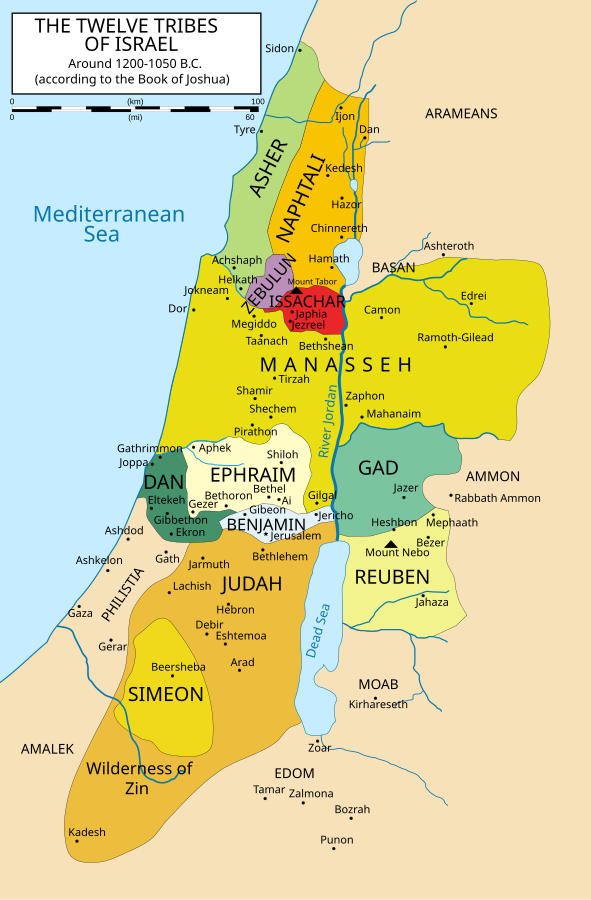
      The map at the top of the page shows the allotment of the land of Canaan to each Israelite tribe according to the result of this final census and the casting of lots. As we can see, the land was not claimed by each individual Israelite as he chose but was settled in tribal units. Within each tribal allotment, the land was further allotted to each of the heads that had descended directly from the tribal patriarch of generations past. We will see a reason for this. Before we do that, however, another reading selection from this Sabbath from Joshua 17, reminds us that the inheritance that would go to the tribe of Manasseh had to be restored of a very important missing part. One of the descendants of Manasseh, Zelophehad, had died in the wilderness, and had only five daughters. The daughters earlier had demanded of Moses that they should be able to inherit their father's future portion of land so that his inheritance would not be lost, saying: "Why should the name of our father be removed (gara - diminish, withdraw, keep back, be restrained) from among his family because he had no son? Give us a possession among our father's brothers." (Num. 26:33, Num. 27:1-4). In verse 11, it is called an (*aleph-tav/Alpha and Omega) inheritance. The LORD told Moses to agree to this request, and inheritance laws were established to reflect this. In Joshua 17:3-6, those five daughters come before Joshua to claim the inheritance that had been promised to them by Moses. Their father's name was preserved within the tribe of Manasseh through his five daughters. His name means "first born" (see also Ex. 13:11-12, Zech. 12:10, Lk. 2:4-7, Rom. 8:28-30, Col. 1:13-18, Rev. 1:4-6). His daughters' names mean "wounded, disease, travail (see Isa. 53:4-5, 11)/ stagger (see Mt. 26:36-39)/ partridge: call, cry out, proclaim, named, invited, preach, summon, bidden, guest, be chosen (see Jn. 7:37-38, Jn. 15:16)/ queen-king, rule and reign (see Ex. 19:5-62 Tim. 2:11-13, Rev. 5:9-10)/ to be pleased with (see Lk. 3:21-22, pleasant land whose city is the seat of the kingdom (see Ps. 16:6, Rev. 21:1-5)." We can see that each descendant's name is important to God, who had agreed that this name should not be lost from the tribe of Manasseh. We can see the identity of the Messiah/Christ Jesus in these names alone. We will see even more of the purpose of God in commanding that the (*aleph-tav/Alpha and Omega) land be settled by tribal identity.

     Keeping in mind the profane idolatrous practices of the inhabitants of Canaan whom the LORD was displacing with the tribes of Israel, the Hebrew meaning of "tribe" being "staves, branches, scepters of ruling, extending, spreading out, causing to yield", becomes very important.  The practices of idolatry by the Canaanites even included human/child sacrifices (see warning: Mt. 19:13-15Mt. 18:5-710). The LORD was casting down false gods, occultic practices and bondages of spiritual darkness with His name and His covenant expressed by the witness of the tribes of His people.

      Isaiah later wrote: "You are My witnesses (ed/ud - witness, evidence, testimony, recorder, prince, commander, legislator/restore, relieve, bear witness, cause to testify, affirm, exhort, enjoin, admonish, charge solemnly, give warning),' says the LORD, 'and My servant whom I have chosen, that you may know and believe Me, and understand that I am He. Before Me there was no God formed, nor shall there be after Me. I, even I, am the LORD, and besides Me there is no savior. I have declared and saved, I have proclaimed, and there was no foreign god among you; therefore you are My witnesses,' says the LORD, 'that I am God." (Isa. 43:10-12). Isaiah also wrote: "Bind up the testimony (te'uda/ud - testimony attestation, precept/ ud - see above), seal (hatam - seal up, affix a seal, marked, lock up, close up - see also Rev. 7:3) the law among my disciples." (Isa. 8:16). Those who are disciples are marked and sealed inwardly and outwardly with the testimony/witness of God's precepts and salvation promises.

     The land of Canaan became covered west to east and north to south with the ruling scepters of the tribes of Israel. These were the tribes who occupied the land, and the witness/testimony found in their names:

Asher - happy, fortunate, to go straight, set right, upright, prosper (Ps. 146:5-7)

Naphtali - wrestling, struggle, twist (Gen. 32:24-30, Eph. 6:12-13)

Manasseh - cause to forget (..."all my toil", Gen. 41:51) (Jer. 31:34Heb. 8:10-13)

Zebulun - exalted habitation, dwell exaltedly, inhabit (Isa. 33:5-6Eph. 2:6-7Jn. 14:2-3)

Issachar - "there is recompense", wages, reward (Isa. 40:10-11Rev. 22:12-14)

Ephraim - "I shall be doubly fruitful", fruitfulness (Jn. 15:4-5)

Gad - troop, invade, attack, overcome, fortune (Mk. 3:27Rev. 12:10-11Rev. 3:12)

Benjamin - "son of the right hand", right side (Rom. 8:34Col. 3:1-3Heb. 12:1-2)

Reuben - "behold a son" (Isa. 9:6-7, Lk. 2:7)

Judah - praised, thanks, confess, shoot arrow (Ps. 34:1-3Lk. 1:67-75)

Simeon - heard, hearing with acceptance, hear, obey, publish, declare (Isa. 52:7Lk. 11:28)

     The witness of the tribes of Israel was against the spiritual powers present in the land and the wicked ways of the Canaanite people of the land which the LORD had promised to Abraham's descendants, and upon which He had set His holy name (Neh. 1:9). The LORD will not allow His (*aleph-tav/Alpha and Omega) holy name to profaned by anyone or anything (Ex. 20:7, Ezek. 36:23-24, Ezek. 39:7) for the sake of His power of salvation, because "Whoever calls upon the name of the LORD shall be saved." (Joel 2:32, Rom. 10:9-13).

     From this land, the spiritual witness of the tribes regarding the LORD God and the Messiah/Christ spread out or extended (see Hebrew word for "tribe" above) throughout the earth. Jesus also said to His disciples after His resurrection: "But you shall receive power when the Holy Spirit has come upon you; and you shall be witnesses to Me in Jerusalem, and in all Judea and Samaria and to the end of the earth." (Acts 1:8).

     From another reading portion from this Sabbath, Joshua, who had led the tribes into the promised land and apportioned the inheritance to each tribe years before, knew that he was soon to die. Understanding the importance of the testimony and witness of the tribes, he gave this solemn warning: "Therefore be very courageous (hazak - strong, strengthened, prevail, be urgent, keep hold of, to tie fast or bind bonds strongly) to keep and to do all that is written in the Book of the Law of Moses, lest you turn aside from it...and lest you go among these nations, these who remain among you. You shall not make mention of the name of their gods...you shall not serve them nor bow down to them, but you shall hold fast to the LORD your God, as you have done to this day. For the LORD has driven out from before you great and strong nations, but...no one has been able to stand against you to this day....Therefore take careful heed to yourselves, that you love the (*aleph-tav/Alpha and Omega) LORD your God. Or else, if...you...cling to the remnant of these nations...and make marriages with them, and go in to them and they to you, know for certain that the LORD your God will no longer drive out these nations from before you. But they shall be snares and traps to you, and scourges on your sides, and thorns in your eyes, until you perish from this good land which the LORD your God has given you." (Josh. 23:6-13).

     It takes strength in the Word of God to resist the urge to adopt and practice the world's ways that defile us and profane the name of the LORD because the pressure and draw is great. Paul wrote that these ungodly strongholds are pulled down when our obedience is fulfilled. (2 Cor. 10:4-6). We have been entrusted with an urgent and important testimony and a witness contained in the new name/character which we have been given by God through Messiah/Christ. (see Isa. 62:1-5, 2 Cor. 5:17-18).

     If you would like to know more about walking out and living our identity purpose, you can pray with me: "Heavenly Father, the tribes of Israel had a witness within them of You, Your Word, Your Messiah/Christ and Your salvation. Lord, by Your Living logos Word Jesus, and Your Holy Spirit, help me to be a living testimony of Your greatness and Your love. For You so loved the world that You gave Your only Son for it, that whoever would believe in Him would not perish but have eternal life. I bless, exalt and magnify Your holy name, the name of My salvation and deliverance. AMEN."

*NOTE: aleph-tav written in Hebrew as אֶת, are the first and last letters of the Hebrew alphabet. The meaning of the two pictographic Hebrew letters can also be interpreted "Adonai (Lord) of the Cross/Covenant". In the New Testament, these letters are translated as Alpha and Omega written as Α Ω , the first and last letters of the Greek alphabet. These letters are those by which Jesus Christ identifies Himself in the Book of Revelation: see Rev. 1:8Rev. 21:6Rev. 22:13.


Friday, July 7, 2023

Fathers

Jesus made this shocking statement to a group of people who believed in Him: "You are of your father, the devil, and the desires of your father you want to do. He was a murderer from the beginning, and does not stand in the truth, because there is no truth in him. When he speaks a lie, he speaks from his own resources, for he is a liar, and the father of it." (Jn. 8:44). Jesus discerned that these "believers" had been deeply angered to the point that they wanted to kill Him (v. 37) because of what He had told them earlier when He said: "If you abide in My word, you are My disciples indeed. And you shall know the truth, and the truth shall make you free (eleutheroo/eleutheros - make free (from dominion of sin), to liberate, deliver/cease to be a slave, exempt from liability)." (v. 31-32). These believers in Christ took great pride and assurance in the fact that their forefather was Abraham, and, because of that, they were already "free". The words of Jesus had offended what they considered to be their spiritual identity and inheritance. However, Jesus pointed out to them that Abraham, whom they claimed as a father, prophetically saw the Day of Christ, and rejoiced in it (v. 56-58). Therefore, they were not of their father, Abraham. As Jesus had correctly discerned their hearts, these "believers", when they heard His words, took up stones to stone Him to death, but He passed through them unharmed (v. 59). In another portion of scripture, Jesus had to rebuke His disciples, and say to them: "You do not know what manner of spirit you are of..." (Lk. 9:51-56). To Peter, Jesus had to issue this rebuke: "Get behind Me, Satan! For you are not mindful of the things of God, but the things of men." (Mk. 8:31-33). The father of pride is not Abraham, nor is it God (Prov. 11:2, Prov. 16:5, 18-19), and it's a problem to all people, including believers. Pride is the self-exaltation of the (deceitful) heart (Jer. 17:9-10). In last week's Sabbath study, the father of the evil spirit of devastation and annihilation was revealed. The "father" of this evil was named after a little twittering sparrow, small when compared to the awesome power that God exercised to protect His people's salvation. God continues to reveal the "father" behind an enemy in an account from this week's Sabbath reading portion titled "Pinchas" (also known as Phinehas, and means "mouth of brass, serpent, mouth of the image of a serpent") from Numbers chapters 25 through 27. The Israelites in the wilderness (B'midbar) were about to learn another devastating, but necessary lesson about a powerful spiritual father, who was not God. Balaam, the soothsayer, had been hired by King Balak of Moab, to curse the people of God in order to make them vulnerable for defeat. However, Balaam could not speak the words of cursing, because God prevented him, and placed the Word of blessing in his mouth instead. However, Balaam advised the enemy king that the people of God could be ruined by the seduction of Moabite women, who would lead them away from God, and into the worship of the Canaanite demon god, Ba'al. Our reading portion begins with the success of this strategy: "Now Israel remained in Acacia Grove/Shittim (ebony bark with black thorns that exude gum Arabic/pierce, scourge, to flog, whip), and the people began to commit harlotry with the women of Moab. They invited the people to the sacrifices of their gods, and the people ate and bowed down to their gods. So Israel was joined (samad - bind, join, fasten, attach oneself to, combine) to Ba'al Pe'or ("lord of the gap"/open wide, gaping), and the anger of the LORD was aroused against Israel." (Num. 25:1-3). In the worship of this Moabite god, the women worshippers would prostitute themselves. This results in that perverse "joining" that is created to the false god referred to in the above verses. Many of these Canaanite gods demanded worship in the form of both male or female prostitutes, and sexual perversion. In contrast, God honorably, lovingly, faithfully and sacredly married Israel to Himself, and in the same manner, Christ honorably, lovingly, faithfully, and sacredly married Himself to His Bride, the believers. The spirits of darkness try to twist and profane the holiest things of God, including the concept of joining by holy marriage. The fact that the Israelites were encamped in the Acacia Grove, with its Hebrew meaning, is significant. We are reminded of the prophecy of the scourging of Jesus the Messiah from Isaiah 53: "But He was wounded for our transgressions, He was bruised for our iniquities,; The chastisement for our peace was upon Him, and by His stripes we are (were) healed." (see also 1 Peter 2:24). We can see the connection between the piercing, scourging stripes of Jesus and our healing. The "scourge" meaning is associated with the Acacia Tree of thorns, as well as the production of gum Arabia, a water-soluble fiber that is found to prevent and treat dietary tract cancers, as well as other cancers. This black thorny tree produces a healing substance. Gum Arabic also has preservative properties, so the ancient Egyptians used it in the embalming of mummies. While in this healing place of thorns, as the people engaged in this terrible "joining" with the women of Moab in the worship of Ba'al, the only way to break that joining was death. Moses ordered the deaths of all of those who were joined in this manner to Ba'al Peor (v. 5). The congregation of Israel were weeping at the door of the tabernacle in sorrow, when one of the Israelite men presented, in the middle of the congregation, a Midianite woman to whom he was joined: "Now when Phinehas (Pinchas) the son of Eleazar, the son of Aaron the priest, saw it, he rose from among the congregation and took a javelin (lance, spear) in his hand; and he went after the man of Israel into the tent and thrust both (sana - meaning includes change, alter, pervert, disguise) of them through, the man of Israel, and the woman through her body/belly (qoba/qabab - abdomen, private parts/curse, execrate [meaning revile, condemn, loathe, regard with disgust, revulsion], pierce, perforate). So the plague was stopped among the children of Israel. And those who died in the plague (magepa/nagap - plague, slaughter/beaten, stumble, stricken, smitten) were twenty-four thousand." (v. 6-9). The LORD said of Phinehas that he showed the zealousness of God for His people. The LORD then bestowed upon Phinehas His promise of a covenant of peace, and an everlasting priesthood for the descendants of Phinehas, because, through the zealousness of God, Phinehas made atonement for the children of Israel and prevented their total destruction. (v. 10-13). We can see the atonement work of Christ here also in the Hebrew meaning of the word "plague". Christ was beaten, stricken, and smitten for our sakes to atone for the plague we deserved (Isa. 53:4,6, Jn. 19:3, Lk. 22:63-64). This sounds like a merciless, violent action, but the breakout of the zeal of God, through Phinehas, was for His people, not against them. Twenty-four thousand, at least, had joined themselves to Ba'al, a hideous, perverse god, a spirit who still exists today, luxuriating in human perversion, idolatry, and the blood of human sacrifices, especially the blood of children, born and unborn. These Israelites were the people of God from whom the Messiah would come, Whose seed and presence they already carried, the Savior Who would provide salvation to the world, breaking the curse of death, atoning for sins, and giving the eternal life of His Father, God, to all who would receive it. The plans of the enemy to pervert and destroy Israel could not be allowed to succeed. God had made a covenant promise to their forefathers, and He would not break it. So who were these two individuals, the Israelite and the Moabite-Midianite woman, who defied God and Moses in front of the whole congregation, and continued in their perverse worship of a demon god? The man's name was Zimri (Zimri/zamar - "my music", celebrated in song/make music, praise, psalms/to trim a vine). His father was Salu (elevation, lifted up, weighed in the balance scale) who was a prince (nasi/nasa - lifted up, vapors which ascend/carry, bear, exalt, rise up, forgive, lift up) of a father's house of the tribe of Simeon (Simeon/sama - hearing with acceptance/hear, obey, understand, perceive, obedient, declare, cause to be heard). This Israelite, Zimri, who was gifted in sacred music including psalms, was born a prince's son. His father was a prince of exaltation, forgiveness and rising. Zimri's father's house was the chief house of the tribe of Simeon, who carried an appointed purpose of hearing (God), obeying and preaching or declaring. No wonder the spiritual enemy was determined to destroy the son of this father's house. The Midianite (meaning "strife. contention"/rule, subjugate, contend, brawling discord/lord, master, ruler, controller) woman was named Cozbi/kazab (meaning "my lie", liar/proven to be a liar). Her father represented a very powerful spiritual enemy. Her father's name was Zur/sauar/sur (meaning "rock"/strength, beauty, mighty one, strong rock of heathen gods/besiege, distress, adversary, assault, shut in, foe). He was "head (ab - father, founder) of the people (em - like father) of a father's house in Midian." (Num. 25:14). This father was not like the "little tweeting, hopping sparrow father" that we saw in the previous Sabbath reading. This father, Zur, the adversary, represented a rock of strength and assault. As the father of Cozbi, the Midianite woman here, and considering the Hebrew meaning of her name, Zur was "the father of proven lies". Jesus told us who this "father of lies" was, above. This father represented Satan, himself (see 1 Peter 5:8-11). As we saw in the account with Jesus above, this father had the ability to lie to even believers in Christ through their weaknesses, in that case murderous pride, of their sinful nature. Peter wrote that we were to take this threat of the devil seriously, be vigilant, and resist the devil, and the God of all grace, glory and dominion would perfect, establish, strengthen and settle us (build us up on His foundation). In the wilderness, the Israelites learned a hard lesson about this father of lies, but as we saw with the little twittering and hopping sparrow father of last week, the plans and purpose of our heavenly Father for His people will not be defeated. After this Ba'al debacle was resolved, the Israelites were numbered again in Numbers Ch. 26. The (aleph-tav/Alpha and Omega - see Rev. 1:8, Rev. 21:6, 22:13)) sum of the males old enough to go to war, was to be done "by their father's houses". (Num. 26:2). By this second numbering, the (aleph-tav/Alpha and Omega) land would be divided and "...they shall inherit according to the names of the tribes of their fathers." (v. 55). Here are some of the meanings of the names of those in this second census who were heads of households within their tribes: Nemuel: "Day of God", Jachin: "the right hand", Shaul: "Dawning and rising of light", Areli: "the lion of God, the son of a hero", Jashub: "He will return", Jahleel: "hoping, expectant of God", Asriel: "Vow/Prince of God". These were just some of the heads of households among the tribes of the fathers of Israel. These heads of households reflected the heavenly Father and His Son in their names. This is the prophetic purpose of the godly names that travelled through the wilderness and inherited the Promised Land. Some time later, the father of Cozbi/lies, Zur, the prince of those like him, would lose his life, along with the soothsayer Balaam and four other princes of Midian. The Israelites, by the command of Moses, and with the presence of Phinehas, "with the holy articles and the signal trumpets in his hand", killed them with the sword (Num. 31:6-8). Sadly, but perhaps not too unexpectedly, the Israelites took the Midianite women alive as captives from this victory. Moses, however, dealt with that situation very quickly! That is a study for another day. If you would like to learn more about our Father, Who is God, you can pray with me: "Our dear heavenly Father of all creation, Your Word does not return to You void, but accomplishes all that You have set it out to do, without exception, especially regarding Your people. There is none other like You. I love You as my good Father, and I love Your Son, Jesus. Keep me, and Your people, in Your Father's heart by the Holy Spirit, and by Your Word of truth that You are teaching me. Let my ears hear, and my heart obey, what You, my Father, are instructing me so that I never stray from my Father's house. You have made me a "son/daughter of God" through Your blessed Son, Jesus, so that I can dwell forever with my heavenly Father. I praise and thank You in Jesus' name for all of these marvelous things. AMEN."

Friday, July 15, 2022

Remnant

Often our eyes become focused on the horrible events happening across the world. Right has become wrong, and wrong has become right, and often it seems that the Church is silent. However, this week's Sabbath reading, titled Pinchas, which is the Hebrew version of the name Phinehas, focuses our eyes on something else - the faithful "remnant" of God. No matter how far astray God's people had gone from Him, He assured us in His Word that He always had a remnant, or preserved remainder, who continued to worship Him, remain obedient to Him, and accomplish great things in His name. We will see the qualities that make up the faithful remnant from this Sabbath's reading. From Number 25, we read that the congregation of the children of Israel had begun to join with idolatrous Moabite women. As they joined themselves to these idolators, the Israelites began to worship the Moabite god, Ba'al, instead of the God of Israel. In last week's entry, we read that Balak, the king of Moab, and also the Midianite people, sought out a soothsayer named Balaam, to get him to curse the Israelites for a reward. God did not allow Balaam to curse His people, but Balaam, we find out later in scripture, told the king of Moab how he could destroy God's people from within the congregation by sending the idolatrous Moabite women into their midst (see Num. 31:16). The Israelites would then leave the worship of their God and turn to the false god, Ba'al, Balaam promised the king. Jesus warned the Church that this kind of strategy is still being used to try to destroy the Body of Christ from within, turning the Church away from the Word of God to embrace the lies of men and devils (see Rev. 2:14-15). Once we fall for a lie, we fall period. This is what the Israelites experienced. As they joined themselves to the Moabite women, they also joined themselves to Ba'al: "...the women of Moab...invited the people to the sacrifices of their gods, and the people ate and bowed down to their gods. So Israel was joined to (samad - to fasten to, attach oneself to, to combine with) Ba'al of Pe'or, and the anger of the LORD was aroused against Israel. Scripture later tells us that the god Ba'al also required the sacrifice of living children in fire (see Jer. 19:4-6, Jer. 32:35, 2 Chron. 28:1-3). As a result of their idolatry, a plague broke out among the congregation of the children of Israel. One man dared to bring his Midianite woman in front of Moses and the weeping congregation standing before the tabernacle. "When Phinehas the son of Eleazar, the son of Aaron the priest saw it, he rose from among the congregation and took a javelin in his hand; and he went after the man of Israel and the Midianite woman, into the tent, and thrust both of them through...So the plague was stopped among the children of Israel. And those who died in the plague were twenty-four thousand." (Num. 25:6-9). The LORD said: "Phinehas...has turned back My wrath from the children of Israel, because he was zealous with My zeal among them, so that I did not consume the children of Israel in My Zeal. Therefore...behold, I give to him My covenant of peace;... to him and his descendants... a covenant of an everlasting priesthood, because he was zealous for his God, and made atonement for the children of Israel." (v. 11-13). Phinehas, out of the whole congregation, acted in zeal (qana -jealousy) for God. God allowed the zeal of Phinehas to satisfy His own, and the plague was stopped. A remnant is zealous for God. However, we are not zealous with natural javelins hurled into flesh and blood. The remnant of the new covenant in Christ is a remnant of the Spirit of God. This remnant does not use natural weapons, but spiritual weapons against spiritual powers, and that warfare begins within ourselves, through our obedience. By this spiritual warfare, we "make atonement" for many. This warfare is so powerful that it pulls down evil spiritual powers and strongholds over whole nations (2 Cor. 10:3-6, Eph. 6:11-18). Although this is spiritual warfare, it comes from the same place of zeal within the remnant as the zeal of Phinehas. The remnant is not here to gaze in horror at the trainwreck of wickedness in the world, but to spiritually act in the zeal of God. In another portion of this Sabbath's reading in Numbers 27, five daughters of Zelophehad (meaning "first born"), were denied their father's inheritance because they were not numbered among the men of Israel. As a result of that omission, they came before Moses and stood for their deceased father's inheritance saying: "Our father died in the wilderness; but he was not in the company of those who gathered together against the LORD...Why should the name of our father be removed from among his family because he had no son?..." (v. 1-4). Moses brought the issue before God and the LORD agreed with Zelophehad's daughters, and commanded that they should receive the inheritance in their father's name. Not only did they inherit, but it became the commandment of God that if a man died with no son, his inheritance should go to his daughter(s) (v. 7-8). A faithful remnant brings an injustice before God, and not only causes the injustice to be changed for themselves, but, as a result of the power of God's righteousness, for many others at the same time. In the same manner, the faithful remnant of the new covenant also stands in the inheritance of the Father's Firstborn Son, Jesus, not only on their own behalf, but on the behalf of many, even all creation (see Rom. 8:16-21, Eph. 1:11-14, Gal. 3:26-29). In another portion from this Sabbath's reading, the great prophet of Israel, Elijah, became overcome with fear and with bitterness against the people of Israel, believing that only he was left to defend the LORD before a wicked, and idolatrous queen and her false prophets (1 Kings 19:10, 14). In bitterness he prayed that he might die, that he had had enough! (1 Kings 19:1-4). It was wrong for Elijah to despise the people, because he was unintentionally despising the remnant in the midst of the people. Although he was a prophet, Elijah was unaware that God had kept a remnant for Himself among the people. God answered Elijah: "Yet I have reserved ( sa'ar- remain, remnant, survive, spare, keep over, to leave as a gift, reserve) seven thousand in Israel, all whose knees have not bowed to Ba'al, and every mouth that has not kissed him." (v. 18). The LORD then commanded Elijah to anoint Elisha to be prophet in his place (v. 16). Elijah was to be removed from his position, and, in a miraculous way, he would be called home to God. In the first chapter of Isaiah, the LORD reveals His Word to the prophet regarding the nation of Israel's evil ways and rebellion against God (v. 2-4). As a result, the nation had been stricken with terrible spiritual wounds (v. 5-6). The nation was desolate in the sight of God, with this exception: "Unless the LORD of hosts had left to us a very small remnant, we would have become like Sodom, we would have been made like Gomorrah..." (v. 7-9). In our despair over rampaging sin and violence, we tend to forget about the remnant of God, and its purpose. However, God does not forget. Their presence in a nation can act as a restraint against total destruction, as the LORD revealed to Isaiah, above. In this case, the LORD directed the remnant into repentance. Would they obey and heed the LORD for the sake of the land? Phinehas made atonement for the people by the zeal of the LORD. In this example From Isaiah 1, atonement could be made by the remnant only through repentance. Do we understand the responsibility and the grace of God given to His remnant? Paul had to remind the smug and prideful Gentile Church that God had a remnant in Israel which He had not forgotten, beloved for the sake of the fathers, called to receive salvation, and that He would keep His promise that "All Israel shall be saved." (Rom. 11:5, 26, 28-29). The hidden remnant in Israel that Paul recognized would act as a seed of salvation for all Israel. Micah 5:7 describes His remnant as being "...like dew from the LORD, like showers on the grass..." in the midst of many peoples. God always has a remnant in the earth, although we may not always see or know them. The remnant stands with and for the LORD, and brings changes to the earth. If you would like to know more about being part of the remnant of God, you can join me in my prayer: "Heavenly Father, You have called a remnant in Your Son, Jesus, led by Your Holy Spirit, to stand in the earth among the people and the nations. Show me how to walk as part of Your remnant, zealous in the Spirit, but not warring against flesh and blood, standing for the name and inheritance of our Father, not to consume it upon myself, but for the benefit of many. In these challenging times, help me to pray for the remnant so that we will walk in obedience, wisdom, truth, and revelation. I ask these things in Jesus' name. AMEN."

Friday, July 2, 2021

Exceptions

There are rules, and then there are the exceptions to those rules. We don't often think that such a thing may be true of God's Law, and His commandments, but I would like to give some examples that were proven to be exceptions to the rule. Those examples come from this week's Sabbath reading titled "Pinchas" from Numbers 25-27. Pinchas is the Hebrew form of the name that we are more familiar with, Phinehas. Although he was Aaron's grandson by Aaron's son, Eleazar, Phinehas was not yet a priest himself at the time we read about him. Most of us are familiar with the situation that had developed within the camp of Israel during this time. The Midianites (meaning "strife") had schemed, with the advice of the soothsayer Balaam (see Num. 31:16 and Rev. 2:14), to corrupt the Israelites from the inside. Midianite women were sent to seduce the Israelite men into turning from the worship of the God of Israel, to the god of the Midianites, Ba'al: "So Israel was joined to Ba'al of Peor (meaning "gap, gaping wide open like the mouth of a ravenous beast"), and the anger of the LORD was aroused against Israel." (Num. 25:3). The LORD commanded Moses that all of the offenders who had joined themselves to Midianite women, and consequently to their god, were to be killed. One man named Zimri (meaning "my music") presented his Midianite wife, Cozbi (meaning "my lie, liar") before Moses and all the congregation who were weeping and repenting at the door of the tabernacle. When Phinehas saw this man and woman present themselves before the tabernacle, he chased them with a javelin into their tent and thrust the javelin with such force, that it went through both Zimri and Cozbi, killing them. This act of Phinehas stopped the plague that had been killing the children of Israel, although 24,000 had already died (v. 8-9). This is what the LORD said to Moses: "Phinehas, the son of Eleazar, the son of Aaron the priest, has turned back my wrath from the children of Israel, because he was zealous with My zeal among them, so that I did not consume the children of Israel in My zeal. Therefore say, 'Behold, I give to him My covenant of peace; and it shall be to him and his descendants after him a covenant of an everlasting priesthood, because he was zealous for his God, and made atonement for the children of Israel." (Num. 25:10-13). Aaron had already died at this point, and Eleazar was now the priest, yet it was Phinehas who burned with the same jealousy as God has for His people (the Hebrew word "qana/qina"), and made the atonement that broke the plague. Phinehas acted as a high priest, although he was not the high priest. The nature of the priesthood prophesied by God for Phinehas would be different from Aaron's or Eleazar's priesthood, because it was to be an everlasting (olam- from antiquity into an unending future) priesthood. From Phinehas' line of descendants would eventually come the Zadok priesthood as well. So our exception to the rule in this case was a man who was not a priest yet by the Law, but was accepted by God in a priestly role. Others, like Korah, who had tried the same thing for selfish reasons in rebellion against God, were judged by God and killed. The exception for Phinehas was created because of his motivation, which was like God's. Another exception to the rule occurred when Moses and Eleazar were told to take a census of all the children of Israel by their father's houses, who were twenty years old and above, and able to go to war (Num. 26:1-4). This would pertain to the males of the camp old enough to fight. Even the sons of the rebels who did not die themselves in the rebellion were included in the census. After the census, the LORD said to Moses: "To these the land shall be divided as an inheritance, acording to the number of names...each shall be given its inheritance according to those who were numbered of them." (Num. 26:53-54). When the children of Israel came into the new land, the land would be allotted according to the men counted in this census. The rule stated by God to Moses was very specific about the future allotment of the land, and very specific regarding who was to be counted to be part of the allotment. We've got a rule, and here comes the exception. Five daughters came forward to stand before Moses, Eleazar the priest, before the leaders, and all the congregation of Israel, by the doorway of the tabernacle saying: "Our father (Zelophehad, meaning "first-born"; root meaning: "wounded" + "first-born") died in the wilderness; but he was not in the company of those who gathered together against the LORD...and he had no sons. Why should the name of our father be removed from among his faamily because he had no son? Give us a possession among our father's brothers." (Num. 27:3-4). This was an incredible demand to make of Moses, the man who spoke by and for God, especially in front of everyone else. Moses could have easily told them that this rule of allotment was the command of the LORD, and not to be contested. However, Moses did not say that. Scripture says, "So Moses brought their case before the LORD." (v. 5). Moses, the leader and intercessor of God's people, brought the issue before the LORD, rather than making the decision himself, even though the commandment of God was clear. From this thoughtful intercession, we get a groundbreaking exception to the Law: "And the LORD spoke to Moses, saying: "The daughters of Zelophehad speak what is right; you shall surely give them a possession of inheritance among their father's brothers, and cause the inheritance of their father to pass to them. And you shall speak to the children of Israel, saying: "If a man dies and has no son, then you shall cause his inheritance to pass to his daughter. If he has no daughter, then you shall give his inheritance to his brothers." (v. 6-9). Not only could daughters inherit, but they were to inherit before their father's brothers. Not only was the exception made for these five daughters, but their argument changed the Law commanded by God regarding inheritance for all daughters in that generation and the generations to come. Who were these five daughters who drew near in unity before Moses and the congregation to argue their case? The number five involved here gives us a clue. Many say that the number five (5) represents "grace". Jewish sources agree saying that the number five means "to be saved, to be rescued; to be saved from out of the world". The names of some of the five daughters seem to create a picture of the Church of Believers: Mahlah means to be pierced, wounded, to pray, to travail. Milcah means the wife of a king, a royal wife. Tirzah means favorable, accepted, delight, approved, pardon, reconcile self, satisfy a debt. If these five daughters do represent the Church, then this is a prophetic picture of what we learn in the New Testament: the Church, who previously had no inheritance, was made to inherit through Christ. That makes me very happy for the exception that was made for the five daughters! Jesus often had to give the experts in the Law of Moses correction as to how they viewed and taught the Law. These experts were always accusing Him of violating the Law, especially regarding the Sabbath. In one case, when Jesus healed on the Sabbath, and came under accusation because of it, He answered: "Which of you having a donkey or an ox that has fallen into a pit, will not immediately pull him out on the Sabbath day?" (Lk. 14:5). Jesus cited an exception to the rule. In another answer He said, "My Father has been working up till now, and I have been working." (Jn. 5:17). If the Father is working, that becomes an exception to the rules of the Sabbath! He concluded by saying, "The Son of Man is Lord even of the Sabbath." (v. 8). Jesus is the Lord of the Sabbath, and He is also the Lord of the Word, because He IS the Word. He reminded the crowd: "But if you had known what this means, 'I desire mercy and not sacrifice', you would not have condemned the guiltless." (v. 7). In another example, Jesus taught about the exception of David and his men eating the shewbread of the tabernacle, which was not lawful for them to eat (Mt. 12:2-4). In all of these things, Jesus reminded us of the true essence of all the Law and the prophets, which is also exhibited by the examples in this week's Sabbath reading: "You shall love the Lord your God with all your heart, with all your soul, and with all your mind. This is the first and great commandment. And the second is like it: You shall love your neighbor as yourself. On these two commandments hang all the law and the prophets." (Mt. 22:37-40). We love the Word and the commandments of God, but we also love the exceptions, because they teach us precious principles in knowing God. If you would like to grow in the knowledge of God, and His Son, Jesus, you can pray: "Lord Jesus, You have fulfilled all of the Law and the prophets. Not one word from them will pass away, until all has been fulfilled. You became the sacrifice that saved me out of the world, pardoned me from my sins, and gave me Your favor before God. You rose from the dead to fulfill the prophesied exception from death, so that I could be an exception from the power of sin and death also. Fill me with the Holy Spirit of truth and righteousness, to teach me Your ways and Your Word. I ask these things in Jesus' name. AMEN."

Saturday, October 14, 2017

Gap


The LORD brings us to different physical and spiritual places. He has us ascend to high places, and descend to low places. He brings us to dry places, and to well watered places. What we learn and do in those various places changes us, and brings change to those places.
This is a story about God's people who were brought to a low place. That place was called Shittim, or the Acacia Grove (Num. 25). By its Hebrew meaning, it is a place of thorns, scourging, flogging. In that place, there were also people of idolatry, the Moabites and Midianites, and their false god, Ba'al Peor, "lord of the gap". This gap can mean a low place, or opening, between mountains. The gap of this name can also refer to a wide opened or gaping mouth, like a mouth opened wide in terror, or opened wide to swallow up.
It is at this place of thorns and scourging that God's people began to join with the women of Moab, and also joined (fastened, be bound, attach) themselves with the false god that the women worshipped, Ba'al. In Ba'al worship, when one is in difficulty and distress, one cuts himself to draw blood, and in severe situations, even offers his oldest child to be burned in fire in order to appease Ba'al, and receive a remedy to the distress. Since Israel was in the spiritual place of acacias or thorns, we can assume that in joining themselves with Ba'al, their blood and their children were offered to Ba'al at this place of distress (Ezek. 20:6). We can also assume this kind of activity was going on because the LORD became extremely angry, and a plague (judgment) of death broke out. Moses told the leaders or judges among the people to execute all who had joined themselves to Ba'al, so that the anger of the LORD would be turned away from Israel. There was great weeping in the presence of the LORD, as the resulting plague that broke out upon them took 24,000 lives.
In the middle of this ongoing plague and weeping, a young man stood in front of Moses and all of Israel with one of these women of Ba'al worship. He was the son of the leader of the tribe of Simeon. Simeon, in Hebrew, means to hear and obey. The young man's name was Zimri ("my music, sing psalms, sing praise, play instruments"). His leader father was Salu, which means "weighed in a balance". Salu had not obeyed by delivering his son for judgment. The woman was one of the Midianite ("strife, brawling, contention, discord") women who had brought Ba'al worship to the Israelites. Her name was Cozbi ("my lie, liar, vain, deceive, proven liar"). She also was the child of a ruler of the Midianites.
Phinehas, a priest of Israel, took a javelin and sent it through Zimri and Cozbi. The javelin ran through Cozbi's belly ("to malign, pierce, perforate, stab with words, to curse"). From within her came "piercing with curses" in her worship of Ba'al, and she, in turn, was pierced by the javelin. When Phinehas pierced these two people with the javelin, the plague of judgment was stopped. The name Phinehas in Hebrew means "mouth (break in pieces) of brass (serpent, snake, fleeing serpent, enchantment, divination)". He destroyed the root of the evil Leviathan spirit (Isa. 27:1) that had come into the middle of the Israelites with their worship of Ba'al Peor. As a result, the LORD promised Phinehas a covenant of peace, and for his descendants, an everlasting priesthood (Num. 25:12-13). If Phinehas hadn't come forward, all of the Israelites would have been destroyed by the plague (Num. 25:11).
Looking back a short distance of time just before this all happened, a seer, Balaam, had been brought to this very place of Peor for the purpose of cursing God's people for the Moabite King, Balak:
"So Balak took Balaam to the top of Peor, that overlooks the wasteland (wilderness, desolation, to ruin, solitary).  Num. 23:28
Sacrifices were made by Balak at this place at Peor to try to bring the curse against God's people (Num. 23:29-30). Balaam was unable to curse Israel, but he did instruct Balak how to destroy Israel by putting the women of Ba'al among them to tempt them away from their God, YHWH (Num. 31:16, Rev. 2:14).
When God's people are in the place of thorns, in the gap of Peor between high places, in the place which faces the desolate, solitary wilderness, it is a place where they are tempted by the enemy to turn to destructive, false alternatives for relief. Jesus was tempted in just such a place, and resisted the temptation with the Word of God (Lk. 4:1-13). He had not been taken to that place by the enemy, but by the Holy Spirit, and when He returned from that place, He came in the power of the Holy Spirit (Lk. 4:14). It is not a pleasant place to be, but it is a place where we have a purpose. Despite all the best laid plans of the enemy, evil can be rooted out and driven out, and in its place, a covenant of peace, and an everlasting priesthood can be established. Let us pray for and encourage one another.

Our Father will bring us to spiritual gaps and acacia groves.

"Embrace This Place" by Among Thorns
https://www.youtube.com/watch?v=NgQeTqvR0ic

"Come Holy Spirit" by Among Thorns
https://www.youtube.com/watch?v=1uoCoIR-1SE

"Breath of Life" by Among Thorns
https://www.youtube.com/watch?v=ragzYfChorY