Showing posts with label tribes. Show all posts

Friday, July 26, 2024

TribalTestimony


     This week's Sabbath reading portion is titled Pinchas, who was also known as Phineas, and covers Numbers 25 through 27. (*Aleph-tav/Alpha and Omega) Phineas (see written Hebrew of Ex. 6:25) was the grandson of Aaron, and because of his zeal for the LORD, his actions stopped a plague that had killed 24,000 Israelites because they had married Moabite/Midianite women and had joined themselves to the women's false god Ba'al (Num. 25:1-9). The name Phinehas means "mouth of brass, break in pieces the hissing serpent/snake/image of a serpent/fleeing serpent; to command, blow away, break in pieces the enchanter/divination/practice of fortunetelling." This challenge to the LORDSHIP of God over the Israelites came shortly before the allotments for the inheritance of the land were officially established.

     The LORD commanded Moses and Eleazar the priest, the son of Aaron who had died, to take a census of all males over the age of twenty, which are those who were able to go to war. The census was taken by tribe separately, and then added together: "These are those who were numbered of the children of Israel: six hundred and one thousand seven hundred and thirty...Each shall be given its inheritance according to those who were numbered of them. But the (*aleph-tav/Alpha and Omega) land shall be divided by lot; they shall inherit according to the names of the tribes of their fathers. According to the lot their inheritance shall be divided between the larger and the smaller." (Num. 26:51-56). The Israelites had traveled through the wilderness by tribes under separate tribal banners, had encamped in specific tribal formation around the tabernacle, and would occupy the (*aleph-tav/Alpha and Omega) land by tribal groups. The word "tribe" is the Hebrew word matte/nata, meaning "staff, branch, staves, correcting rod, ruling scepter, throwing lance, support of life/stretch out, extend, cause to yield, spread." The "tribe" had to do with the ruling royal scepter and extending authority. 

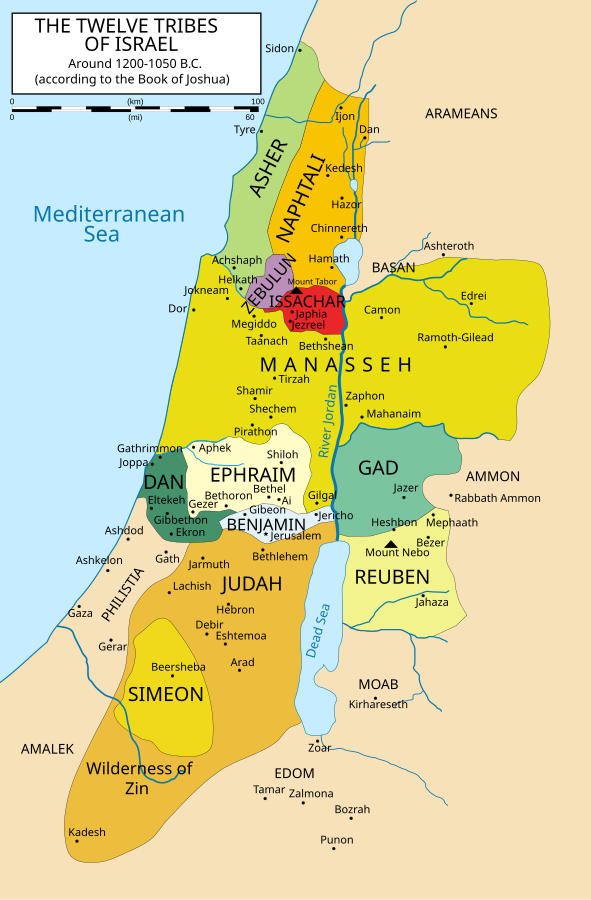
      The map at the top of the page shows the allotment of the land of Canaan to each Israelite tribe according to the result of this final census and the casting of lots. As we can see, the land was not claimed by each individual Israelite as he chose but was settled in tribal units. Within each tribal allotment, the land was further allotted to each of the heads that had descended directly from the tribal patriarch of generations past. We will see a reason for this. Before we do that, however, another reading selection from this Sabbath from Joshua 17, reminds us that the inheritance that would go to the tribe of Manasseh had to be restored of a very important missing part. One of the descendants of Manasseh, Zelophehad, had died in the wilderness, and had only five daughters. The daughters earlier had demanded of Moses that they should be able to inherit their father's future portion of land so that his inheritance would not be lost, saying: "Why should the name of our father be removed (gara - diminish, withdraw, keep back, be restrained) from among his family because he had no son? Give us a possession among our father's brothers." (Num. 26:33, Num. 27:1-4). In verse 11, it is called an (*aleph-tav/Alpha and Omega) inheritance. The LORD told Moses to agree to this request, and inheritance laws were established to reflect this. In Joshua 17:3-6, those five daughters come before Joshua to claim the inheritance that had been promised to them by Moses. Their father's name was preserved within the tribe of Manasseh through his five daughters. His name means "first born" (see also Ex. 13:11-12, Zech. 12:10, Lk. 2:4-7, Rom. 8:28-30, Col. 1:13-18, Rev. 1:4-6). His daughters' names mean "wounded, disease, travail (see Isa. 53:4-5, 11)/ stagger (see Mt. 26:36-39)/ partridge: call, cry out, proclaim, named, invited, preach, summon, bidden, guest, be chosen (see Jn. 7:37-38, Jn. 15:16)/ queen-king, rule and reign (see Ex. 19:5-62 Tim. 2:11-13, Rev. 5:9-10)/ to be pleased with (see Lk. 3:21-22, pleasant land whose city is the seat of the kingdom (see Ps. 16:6, Rev. 21:1-5)." We can see that each descendant's name is important to God, who had agreed that this name should not be lost from the tribe of Manasseh. We can see the identity of the Messiah/Christ Jesus in these names alone. We will see even more of the purpose of God in commanding that the (*aleph-tav/Alpha and Omega) land be settled by tribal identity.

     Keeping in mind the profane idolatrous practices of the inhabitants of Canaan whom the LORD was displacing with the tribes of Israel, the Hebrew meaning of "tribe" being "staves, branches, scepters of ruling, extending, spreading out, causing to yield", becomes very important.  The practices of idolatry by the Canaanites even included human/child sacrifices (see warning: Mt. 19:13-15Mt. 18:5-710). The LORD was casting down false gods, occultic practices and bondages of spiritual darkness with His name and His covenant expressed by the witness of the tribes of His people.

      Isaiah later wrote: "You are My witnesses (ed/ud - witness, evidence, testimony, recorder, prince, commander, legislator/restore, relieve, bear witness, cause to testify, affirm, exhort, enjoin, admonish, charge solemnly, give warning),' says the LORD, 'and My servant whom I have chosen, that you may know and believe Me, and understand that I am He. Before Me there was no God formed, nor shall there be after Me. I, even I, am the LORD, and besides Me there is no savior. I have declared and saved, I have proclaimed, and there was no foreign god among you; therefore you are My witnesses,' says the LORD, 'that I am God." (Isa. 43:10-12). Isaiah also wrote: "Bind up the testimony (te'uda/ud - testimony attestation, precept/ ud - see above), seal (hatam - seal up, affix a seal, marked, lock up, close up - see also Rev. 7:3) the law among my disciples." (Isa. 8:16). Those who are disciples are marked and sealed inwardly and outwardly with the testimony/witness of God's precepts and salvation promises.

     The land of Canaan became covered west to east and north to south with the ruling scepters of the tribes of Israel. These were the tribes who occupied the land, and the witness/testimony found in their names:

Asher - happy, fortunate, to go straight, set right, upright, prosper (Ps. 146:5-7)

Naphtali - wrestling, struggle, twist (Gen. 32:24-30, Eph. 6:12-13)

Manasseh - cause to forget (..."all my toil", Gen. 41:51) (Jer. 31:34Heb. 8:10-13)

Zebulun - exalted habitation, dwell exaltedly, inhabit (Isa. 33:5-6Eph. 2:6-7Jn. 14:2-3)

Issachar - "there is recompense", wages, reward (Isa. 40:10-11Rev. 22:12-14)

Ephraim - "I shall be doubly fruitful", fruitfulness (Jn. 15:4-5)

Gad - troop, invade, attack, overcome, fortune (Mk. 3:27Rev. 12:10-11Rev. 3:12)

Benjamin - "son of the right hand", right side (Rom. 8:34Col. 3:1-3Heb. 12:1-2)

Reuben - "behold a son" (Isa. 9:6-7, Lk. 2:7)

Judah - praised, thanks, confess, shoot arrow (Ps. 34:1-3Lk. 1:67-75)

Simeon - heard, hearing with acceptance, hear, obey, publish, declare (Isa. 52:7Lk. 11:28)

     The witness of the tribes of Israel was against the spiritual powers present in the land and the wicked ways of the Canaanite people of the land which the LORD had promised to Abraham's descendants, and upon which He had set His holy name (Neh. 1:9). The LORD will not allow His (*aleph-tav/Alpha and Omega) holy name to profaned by anyone or anything (Ex. 20:7, Ezek. 36:23-24, Ezek. 39:7) for the sake of His power of salvation, because "Whoever calls upon the name of the LORD shall be saved." (Joel 2:32, Rom. 10:9-13).

     From this land, the spiritual witness of the tribes regarding the LORD God and the Messiah/Christ spread out or extended (see Hebrew word for "tribe" above) throughout the earth. Jesus also said to His disciples after His resurrection: "But you shall receive power when the Holy Spirit has come upon you; and you shall be witnesses to Me in Jerusalem, and in all Judea and Samaria and to the end of the earth." (Acts 1:8).

     From another reading portion from this Sabbath, Joshua, who had led the tribes into the promised land and apportioned the inheritance to each tribe years before, knew that he was soon to die. Understanding the importance of the testimony and witness of the tribes, he gave this solemn warning: "Therefore be very courageous (hazak - strong, strengthened, prevail, be urgent, keep hold of, to tie fast or bind bonds strongly) to keep and to do all that is written in the Book of the Law of Moses, lest you turn aside from it...and lest you go among these nations, these who remain among you. You shall not make mention of the name of their gods...you shall not serve them nor bow down to them, but you shall hold fast to the LORD your God, as you have done to this day. For the LORD has driven out from before you great and strong nations, but...no one has been able to stand against you to this day....Therefore take careful heed to yourselves, that you love the (*aleph-tav/Alpha and Omega) LORD your God. Or else, if...you...cling to the remnant of these nations...and make marriages with them, and go in to them and they to you, know for certain that the LORD your God will no longer drive out these nations from before you. But they shall be snares and traps to you, and scourges on your sides, and thorns in your eyes, until you perish from this good land which the LORD your God has given you." (Josh. 23:6-13).

     It takes strength in the Word of God to resist the urge to adopt and practice the world's ways that defile us and profane the name of the LORD because the pressure and draw is great. Paul wrote that these ungodly strongholds are pulled down when our obedience is fulfilled. (2 Cor. 10:4-6). We have been entrusted with an urgent and important testimony and a witness contained in the new name/character which we have been given by God through Messiah/Christ. (see Isa. 62:1-5, 2 Cor. 5:17-18).

     If you would like to know more about walking out and living our identity purpose, you can pray with me: "Heavenly Father, the tribes of Israel had a witness within them of You, Your Word, Your Messiah/Christ and Your salvation. Lord, by Your Living logos Word Jesus, and Your Holy Spirit, help me to be a living testimony of Your greatness and Your love. For You so loved the world that You gave Your only Son for it, that whoever would believe in Him would not perish but have eternal life. I bless, exalt and magnify Your holy name, the name of My salvation and deliverance. AMEN."

*NOTE: aleph-tav written in Hebrew as אֶת, are the first and last letters of the Hebrew alphabet. The meaning of the two pictographic Hebrew letters can also be interpreted "Adonai (Lord) of the Cross/Covenant". In the New Testament, these letters are translated as Alpha and Omega written as Α Ω , the first and last letters of the Greek alphabet. These letters are those by which Jesus Christ identifies Himself in the Book of Revelation: see Rev. 1:8Rev. 21:6Rev. 22:13.


Friday, July 22, 2022

Tribes

This week's Sabbath reading from Numbers 32 titled Mattot, meaning "Tribes", deals with a strange event. Moses and the children of Israel were encamped on the east side of the Jordan River. Soon, under the leadership of Joshua, they would cross over the Jordan River, and secure their inheritance in the land promised by God which was located west of the River. However, the leaders of the tribes of Reuben and Gad approached Moses and Eleazar the high priest (Aaron had died earlier), and the other leaders of the congregation with a shocking request: "If we have found favor in your sight, let this land be given to your servants as a possession. Do not take us over the Jordan." (Num. 32:5). The tribes of Reuben and Gad, who had "a very great multitude of livestock", had seen how excellent the land on the eastern side of the Jordan was for grazing livestock, and wanted to remain there. This was shocking to Moses, who angrily told them that their request to remain behind, east of the Jordan, would discourage the rest of the Israelites from crossing over, just like the bad report of the ten spies had done previously. That previous failure to enter the land had caused the LORD to become angry, and the Israelites had had to wander the wilderness as a result for forty years! (v. 6-13). Moses said to the leaders of the two tribes: "And look! You have risen in your fathers' place, a brood of sinful men, to increase still more the fierce anger of the LORD against Israel. For if you turn away from following Him, He will once again leave them in the wilderness, and you will destroy all these people." (v. 14-15). These are strong words of condemnation for what Moses saw as an act that would bring destruction to all of the people of God. It might also have been shocking to Moses personally, because God had already told him that he would not enter the promised land himself. He would later beg God to let him go into the land, but be denied: "I pray, let me cross over and see the good land beyond the Jordan, those pleasant mountains and Lebanon." (Deut. 3:25). Moses might have wondered how these two tribes could refuse the land that God had apportioned for them, when Moses loved the promise of it so much, but could never enter it himself. We do not know how the LORD felt about the request of the two tribes to remain on the eastern side of the River, because we have no indication in scripture that Moses consulted the LORD on this issue. We will perhaps have a glimpse of the LORD's thoughts on it because later when six cities of refuge were commanded by God as a haven for those who kill accidently, He assigned three of the cities of refuge to be located on the eastern side of the Jordan, as well as the three cities of refuge that were to be located on the western side of the River. (Josh. 20:1-3, 7-9). Meanwhile back to our story: upon hearing how angry Moses was, the leaders of the two tribes of Reuben and Gad assured him that while they would leave their wives, children, and livestock settled on the eastern side of the Jordan, the men of the tribes would arm themselves and fight with the rest of the Israelites to subdue the promised land on the other side of the River, until Israel was securely inhabiting the land (v. 16-28). Moses agreed that if they kept this commitment to fight with the rest of Israel for the land, they could then return to the eastern side of the Jordan "and be blameless before the LORD and before Israel; and this land shall be your possession before the LORD." (v. 20-22). The half-tribe of Manasseh, who descended from Joseph, also split at this time, with half of the half-tribe wanting to remain on the eastern side of the Jordan, and half planning to cross over with the other tribes. Moses agreed (v. 33). We would read later that under the leadership of Joshua (Moses had died by that point), the tribes of Reuben, Gad and half of the half-tribe of Manasseh did keep their commitment to fight on the western side of the River with Israel, and Joshua therefore released them to return to their homes on the eastern side. (Joshua 22:1-4). However, Joshua gave them this warning before the men returned to the east: "But take careful heed to do the commandment and the law which Moses the servant of the LORD gave you on the other side of the Jordan...to love the LORD your God, to walk in all His ways, to keep His commandments, to hold fast to Him, and to serve Him with all your heart and with all your soul. So Joshua blessed them and sent them away, and they went to their tents." (Josh. 22:4-6). It must have been a heartbreaking moment for Israel to watch the men of those tribes who had fought with them, walking eastward, and leaving them. There came another issue concerning the tribes on the eastern side of the Jordan River. A "report" had gotten back to Joshua and the children of Israel that the eastern tribes had built a great, impressive altar on their land, and Israel prepared itself to go to war against those eastern tribes. They sent Phinehas and ten rulers from the western tribes to find out what was happening across the Jordan (Josh. 22:10-14). These leaders spoke sternly to the eastern tribes of Reuben, Gad, and part of Manasseh, calling the building of an altar, other than the altar of the LORD in the tabernacle, treachery and rebellion against the LORD that would cause the anger of the LORD to break out on the whole congregation of Israel (v. 15-19). The three eastern tribes explained that their altar was not in rebellion to God, but that they wanted it to stand as a witness (ed - witness, testimony, evidence, recorder; affirm solemnly, restore, give warning) to future generations that while they were physically separated by the River from the other tribes, they had not separated themselves from the service and worship of the LORD God (v. 21-29). Phinehas and the rulers of the western tribes found this to be acceptable. Where there had previously been a situation of impending war between the western tribes and the eastern tribes, Phinehas now said instead: "This day we perceive that the LORD is among us, because you have not committed this treachery against the LORD. Now you have delivered the children of Israel out of the hand of the LORD." (v. 30-31). Divisions as seen by the eyes of men, are not always seen as such in the eyes of the LORD. He knows who is with Him, and who is against Him. Many centuries later, Jesus had no problem preaching and healing on the eastern side of the Jordan River. The Gospel accounts (Mt. 8:28-34, Mk. 5:1-20, Lk. 8:26-37) tell of a miraculous delivery by Jesus of a maniacal man living among the tombs in Gadarene/Gergesenes who was possessed by many demons. Jesus freed him and restored his right mind. Gadarene/Gergesenes was on the eastern side of the Jordan River, and Jesus is recorded as having "crossed over" to get to that side. We see recorded in the Gospels that Jesus travelled and ministered in the Decapolis (Mk. 5:20, Mt. 4:25), which is a large territory of ten cities. Some of the cities of the Decapolis were on the eastern side of the Jordan River according to maps of the region. The title of this Sabbath's reading is Mattot in Hebrew, meaning "tribes". The singular is matte, meaning "tribe, staff, rod, branch (of a vine), company led by a chief with a staff, branch as extending, rod- whether for chastening, ruling (sceptre), throwing (lance) or walking (as support of life)". The Hebrew word for tribe seems to be more about the rod and staff, and who leads, corrects, guides and supports the walk with that rod and staff, and only then, includes the company that follows after that rod and staff. The believers in Christ follow Him as He leads us with His rod and His staff (Ps. 23, Rev. 2:26-27, Rev. 19:11-16) . According to the Hebrew meaning of the word, we can say that we are of the matte, or tribe of Christ. The believers in Christ unfortunately appear to have many divisions among them of geography, culture, customs, traditions, denominations, even doctrines. Although we may look at each other suspiciously, and sometimes even look to make war with each other, if we are following Christ and His rod and staff, we are united with each other as His tribe. Regardless of those things that divide us, what will continue to unite us is our common faith in the Lord, Who died for our sin, and raised us from the dead by the power of the Holy Spirit to the glory of our Father in heaven. Paul described the believers in Christ as individual members, but joined and working together in one Body - the Body of Christ (1 Cor. 12:12-20, Eph. 4:15-16). This is our unity, and our common identity in our faith, and in our tribe. If you would like to know more about being part of the tribe of Jesus Christ, you can pray with me: "Lord Jesus, Your rod and staff guide me, correct me, support my walk, and comfort me. They identify me as being part of Your tribe. Your Words of Truth guide Your tribe, and not the words or ideas of men. By the presence of Your Holy Spirit, keep me under Your direction, and lead me into the unity of the faith of the Son of God. I ask this in Jesus' name. AMEN."

Monday, February 15, 2016

"ites" - Part 2


The ten tribes to be dispossessed from the land in Gen. 15, are continued here from Part 1 (see entry above this one):

Rephaims- This one was a shocker to me. The word "Rephaim" translates as "Whom Jehovah Healed". This means to heal, to repair, casting down, throw down, hero, champion. These people were an extremely ancient tribe of giants.  By their name, I can only assume that these giants were originally meant to be heroes who healed and repaired. Perhaps because of the circumstances of their origin, their purpose became twisted into that of giants who challenged God's people, instead of bringing healing to them.
We are to be champions who are vessels of God's healing and restoration. This is such a noble, and wonderful call. Will I do God's healing work with my life? I hope so.
"And they shall rebuild the old ruins, they shall raise up the former desolations, and they shall repair the ruined cities, the desolations of many generations."   Isa. 61:4
"And you shall be called the "Restorer of the Breach", the "Restorer of Paths to Dwell in."
                                                                                                             Isa. 58:12b
Amorites- This means "a sayer". It means prominence, publicity, mountaineers, those who live on the heights. It means to think, to say, to will, to answer in one's heart, to promise, to intend, to bring to light. This tribe was the greatest and most powerful of the ten tribes. The name also means to boast, to act proudly, to avow, to lift one's self up, to boast of one's self.
Those who were given a prominent position, a position in the heights, proclaimed themselves, rather than the glory of God. They used their power to enforce their own will and words, rather than God's. I recognize how easy it is to cross from the privilege of speaking God's Word, into the snare of speaking my own word, from ascending the heights for God's glory, to ascending for my own glory instead, boasting of myself instead of proclaiming the greatness of God. Lucifer was judged in the following scripture for just this:
"For you have said in your heart: I will ascend into heaven, I will exalt my throne above the stars of God; I will also sit upon the mount of the congregation...I will ascend above the heights of the clouds, I will be like the Most High."          Isa. 14:13-14
Canaanites- This tribe also descended from Ham, the son of Noah, who disrespected his father's headship, and cast humiliation upon him. These were lowland dwellers, and they are associated with merchants, traders, and traffickers. The name also describes zealots. They were zealous, not for the things of God, but in money and trade. The meaning also includes to subject, humiliate, to be humbled, to be brought low, to surrender, to be depressed.  Nothing seems to bring us as low, as depressed to the point of defeat, as economic and financial trouble. However, to surrender to those feelings means to bow the knee to this tribe of Canaan. It's a powerless feeling when we find ourselves captured in this stronghold of traders. However, as Joseph was bought and sold, he found his way to freedom staying faithful to the will of God in all of his circumstances. This is a huge challenge, especially in these times as powers zealously buy, sell and trade, often at the expense of others. I want to maintain an attitude of thanksgiving in all circumstances, and not spend my life chasing after the things that have their end in a landfill. The world is running to the Canaanites to buy and sell, but God is calling us to cast them out of the land.
"The fruit that your soul longed for has gone from you, and all the things which are rich and splendid have gone from you, and you shall find them no more at all. The merchants of these things, who became rich by her, will stand at a distance for fear of her torment, weeping and wailing, and saying, "Alas, alas, that great city that was clothed in fine linen, purple, and scarlet, and adorned with gold and precious stones and pearls! For in one hour such great riches came to nothing!"  Rev. 18:14-17a
Girgashites- This tribe is different from the others because very little can be found to describe them. However, even that says much. Their name means to dwell on clay-like soil. Not much can be grown in clay. The soil is dense, and water runs off instead of penetrating, or percolating through. Seeds planted in clay will not grow to bear fruit. Even by Josephus' time, he said nothing was known of these people. I don't want to be so dense that the Lord cannot water me, and the seed of His Word cannot grow in me. I want my generations to thrive before the Lord, so we do not become a people no longer known in the earth. I want my life to be fruitful, with fruit that lasts. If I am clay at all, let it be clay that can be molded in the Potter's hands.
"And I will also take some of them for priests and Levites says the LORD. For as the new heavens and the new earth which I will make shall remain before Me, says the LORD, so shall your descendants and your name remain."          Isa. 66:21-22
Jebusites- These were descendants of Jebus, third son of Canaan, son of Ham. Their name means threshing floor. It means trodden down, tread down, reject, trample down. It means to kick out the foot reflexively like an infant, to loath, desecrate as a thing neglected and despised, to be polluted, to tread in a holy place polluting and profaning it, to trample to pieces. This stronghold loathes, rejects and profanes the people and things of God. This is a most serious condition. A person who loves the things of God, would never knowingly want to be a part of this stronghold. However, it is easy to be pulled into the trap of profaning people who belong to God, whom we don't understand, because they are not like us, their doctrine is not like ours, their practices are not like ours. We also can profane ourselves. My body is the temple of the Holy Spirit, and, if I am a priest of the LORD, than I wear upon my head "Holy Unto The LORD", yet I know that I do not always treat with respect and reverence this body. Am I profaning something holy to the LORD? The answer has to be , "yes". My hope and prayer is that I honor all of those things that the atoning blood of Jesus, and the living Word of God has sanctified and made holy, including my own self.
"I beseech you therefore, brethren, by the mercies of God, that you present your bodies a living sacrifice, holy, acceptable to God, which is your reasonable service (spiritual worship). And do not be conformed to this world, but be transformed by the renewing of your mind, that you my prove what is that good and acceptable and perfect will of God."
                                                                                   Romans 12:1-2

As the spies of Israel were sent forth to report on the promised land, most came back fearful of the fierce tribes they saw inhabiting it. However, two came back to give a different report:
..."Let us go up at once and take possession, for we are well able to overcome it." 
                                                                                   Num. 13:30


Our Father has called us to take possession of the land.

"Overcome"
https://www.youtube.com/watch?v=FqXZD_z3eCc

"Redeemed"
https://www.youtube.com/watch?v=VzGAYNKDyIU